







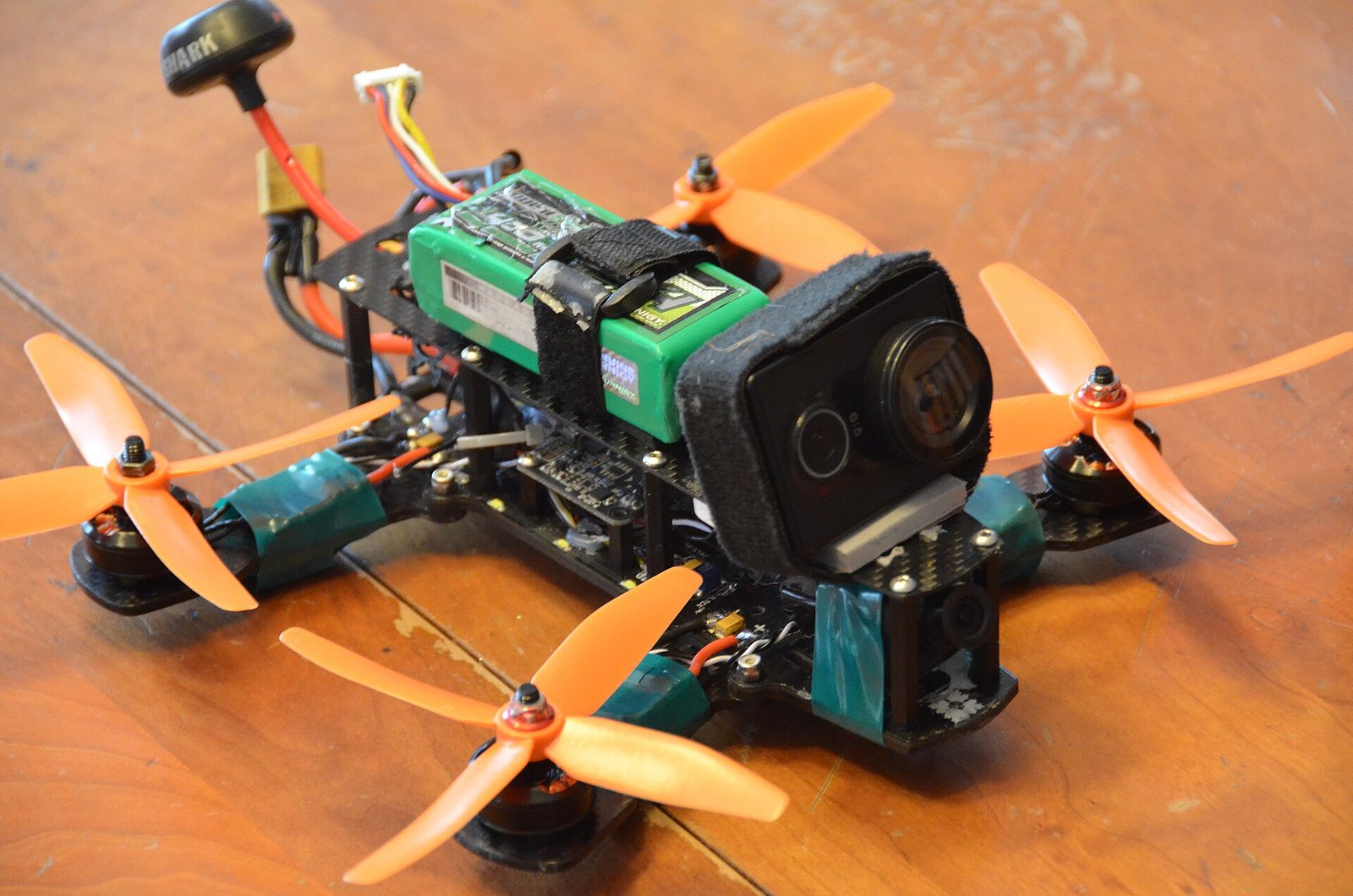
The kamikaze quadcopter banks sharply, locks onto a Russian military vehicle and dives. Another drone hovers over an airfield. A strike narrowly misses a jet but hits three men identified as Russians.
Footage of first-person-view drones hunting Russian troops has become commonplace in the war in Ukraine. But these videos are not from Ukraine. They are from Mali, 5,000 kilometres away on the edge of the Sahara Desert.
Filmed by Tuareg-led separatists and an al Qaeda affiliate during their joint assault on Mali’s army and its Russian paramilitary backers in April, the videos show how battlefield craft honed in Ukraine has become a major factor in the resurgence of rebels across the Sahel.
Armed with drones costing a few hundred dollars, insurgents in Mali, Burkina Faso, Niger and beyond have robbed government forces of the air superiority they once commanded with fighter jets and attack helicopters. Now their multimillion-dollar hardware is constantly threatened from above, as is critical infrastructure including gold mines, fuel depots, pipelines and ports — and even distant capital cities.
“In the past, the state always had the monopoly of the sky. It was the one thing they could control,” said Niccola Milnes, an independent senior counterterrorism and security adviser. “Now that non-state actors can access these drones cheaply and modify them and attach payloads, it’s obviously completely upended that.”
The shift began in 2023, as first-person-view drones armed with basic explosives proliferated in Ukraine. The cheap technology and new expertise soon reached West Africa, helped in part by Ukrainians keen to hurt Russian forces wherever possible, according to the separatists in Mali and experts on the conflict.
Russia began backing Mali’s military government against jihadists and Tuareg-led separatists in 2021 with the deployment of the Wagner mercenary group. In 2023, the Russian Defence Ministry created Africa Corps, a paramilitary force that replaced Wagner and absorbed many of its fighters.
That same year, the separatists were trained to use drones by Ukrainians during a 30-day course at a location outside Mali, said Mohamed Elmaouloud Ramadane, a spokesman for the group, now known as the Azawad Liberation Front (FLA). The claim has not been independently confirmed: Ukraine’s foreign ministry firmly rejected accusations by Mali and Niger that Kyiv supports illegal armed groups, and Reuters said it was unable to determine who from Ukraine had helped the FLA. Neither Ukraine’s military nor its intelligence services responded to requests for comment.
In July 2024, about ten months after the training, the separatists’ dedicated “Unit 6” drone team first unleashed one-way attack drones against Russian and Malian forces during the battle for the town of Tinzaouaten on the Algerian border, Ramadane said. By then, al Qaeda’s affiliate JNIM had already deployed attack drones in Mali.
JNIM is now the region’s most prolific drone user. Previously unpublished data from the conflict monitoring group ACLED show it has carried out 187 drone attacks since 2023 through mid-November — 81 in 2025 and 96 so far this year. Including the FLA and its predecessors, the number rises to 235 attacks across four West African countries. Islamic State West Africa Province has used attack drones 15 times since 2024, mostly against Nigeria’s military.
The FLA, meanwhile, has become one of the most advanced non-state drone operators in the world, according to Milnes and analyst Rida Lyammouri. In March it used roughly 25 drones in two waves to attack an air defence system at the airport in Gao, northern Mali’s biggest city — the first “drone swarm” attack by a non-state group in the Sahel. It has also adopted fibre-optic drones, a technology used widely in Ukraine to bypass electronic jamming.
“The economics favour the attacker: a munition costing a few hundred dollars can threaten aircraft, fuel depots and bases that are worth millions,” said Justyna Gudzowska, executive director of The Sentry, an investigative and policy group.
Governments are struggling to respond. Of 245 strikes documented in a study by the Policy Center for the New South, only ten were met with interception, jamming or surface-to-air missile fire. Most rely on larger, long-range drones made by Turkey’s Bayraktar or Chinese manufacturers, and Burkina Faso recently displayed a sophisticated new air defence system acquired from China — though analysts said such systems were not best suited to fighting insurgents.
Russia’s Africa Corps is now trying to regain momentum with ZALA Lancet suicide drones, according to a report by the Conflict Insights Group this month, and videos posted in October showed Shahed-style drones hitting FLA heartlands near Algeria.
“So far, it is non-state armed actors, and not Africa’s militaries, that are most effectively taking advantage of this shift,” said Nate Allen, associate professor of security studies at the Africa Center for Strategic Studies.
Sources: Reuters, “African insurgents take war to the skies with off-the-shelf drones”, https://www.reuters.com/world/africa/african-insurgents-take-war-skies-with-off-the-shelf-drones-2026-11-25/