








Astronomers have watched a giant star swallow its smaller companion whole, capturing a stellar merger from start to finish for the first time.
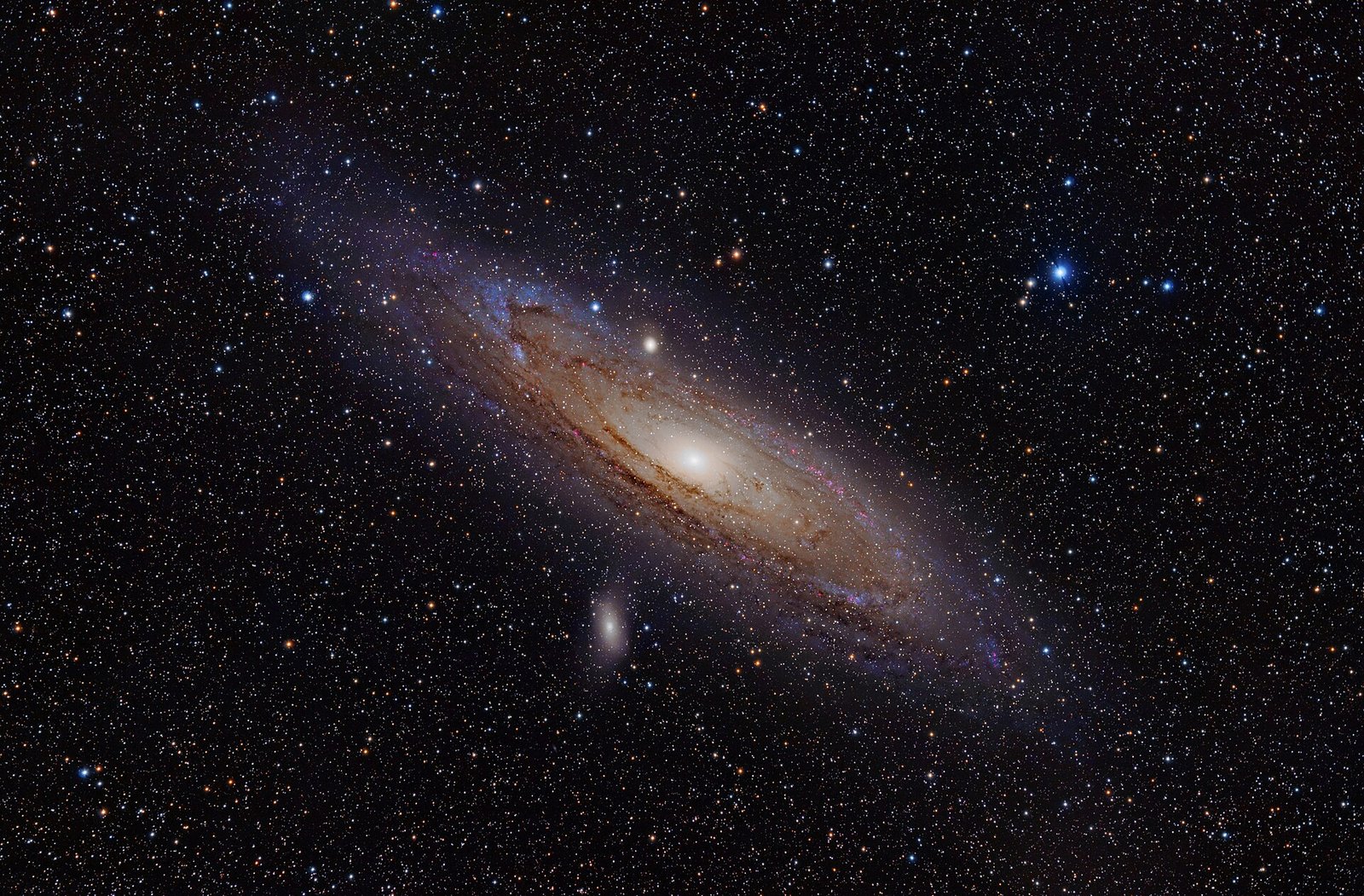
The doomed pair circled each other for thousands of years in the outskirts of the Andromeda galaxy, some 2.5 million light-years from Earth. The larger star, nicknamed Big Bao, was a swollen red giant about seven times as massive as the Sun, with 350 times its radius and 18,000 times its luminosity. Its companion, Little Bao, was slightly smaller and dimmer than the Sun, at about 0.7 solar masses.
The trouble began in February 2023, when astronomers spotted the system brightening in data from NASA’s retired NEOWISE telescope. The slow brightening continued through 2024, and by July 2025 a survey by NASA’s SPHEREx telescope picked up a rapid infrared flare as the system faded in visible light. On 17 October 2025, the Zwicky Transient Facility detected the eruption as the star brightened and heated sharply, reaching a peak within about a week and shining roughly a million times brighter than the Sun.
From first contact — the moment the smaller star began skimming the giant’s surface — to the final plunge into its core took just seven orbits, about seven years. In other observed mergers between smaller stars, that process has taken thousands of orbits. As the companion moved through the giant’s outer layers, the drag of the shared gas envelope bled energy from its orbit and pulled it steadily inward. The encounter was, in the words of co-author Kishalay De of Columbia University, “almost like a bomb exploding inside a living star”.
NASA’s James Webb Space Telescope observed the system on 24 December 2025, just 47 days after the eruption peaked — the earliest follow-up of a merger of this kind. Webb’s mid-infrared measurements of dust shed over centuries helped the team pin down the companion’s mass and reconstruct the event. The study, led by Viraj Karambelkar of Columbia University and published in the journal Nature on 18 November 2026, combined observations from ground and space telescopes across ultraviolet, visible, near-infrared and mid-infrared light.
The merger matters far beyond one pair of stars. The shared-envelope phase the team observed is a key stage in the lives of binary stars, shaping systems that can later explode as supernovae, leave behind neutron stars or black holes, or produce gravitational waves when compact pairs eventually collide. Astronomers usually have to reconstruct this stage from systems that went through it hundreds or thousands of years ago; Bao is the first they have watched unfold in real time. The team estimates the eruption ejected roughly 0.1 to 0.2 solar masses of material from the giant.
Future observations may reveal how much mass the merged star retains as it settles, and NASA’s Nancy Grace Roman Space Telescope is expected to catch many more such events as they brighten. “There’s going to be a large influx of similar discoveries just ahead,” Karambelkar said.
Sources: SciTechDaily — https://scitechdaily.com/astronomers-watch-a-giant-star-devour-its-companion-in-a-rare-cosmic-event/ ; Nature (Karambelkar et al., 18 November 2026, DOI: 10.1038/s41586-026-11221-z) — https://www.nature.com/articles/s41586-026-11221-z ; Gizmodo — https://gizmodo.com/astronomers-watch-a-giant-dying-star-devour-its-smaller-companion-2000846177