







New Zealand woke on Sunday without knowing who will govern it, after Saturday’s general election ended in a near-deadlock between the ruling centre-right National Party and the main opposition Labour Party. Preliminary results from the Electoral Commission showed both parties polling just under 30 per cent of the party vote, separated by only a few hundred votes.
Labour finished marginally ahead in the party vote, but National won more electorate seats and remains the largest party in parliament, with 42 seats to Labour’s 36. A projection from the Electoral Commission gives the incumbent three-party coalition — National alongside the libertarian ACT Party and the populist New Zealand First — 67 seats, a wafer-thin majority in a parliament enlarged by overhang seats.
That slim margin may not survive the final count. Special votes, including ballots cast overseas and outside voters’ home electorates, will not be included until official results are declared on 27 November, and they have historically favoured left-leaning parties. If the coalition loses its majority, either it or a left-leaning grouping would need the support of the centrist Opportunity Party, which enters parliament for the first time after clearing the five per cent threshold with about 5.9 per cent of the vote.
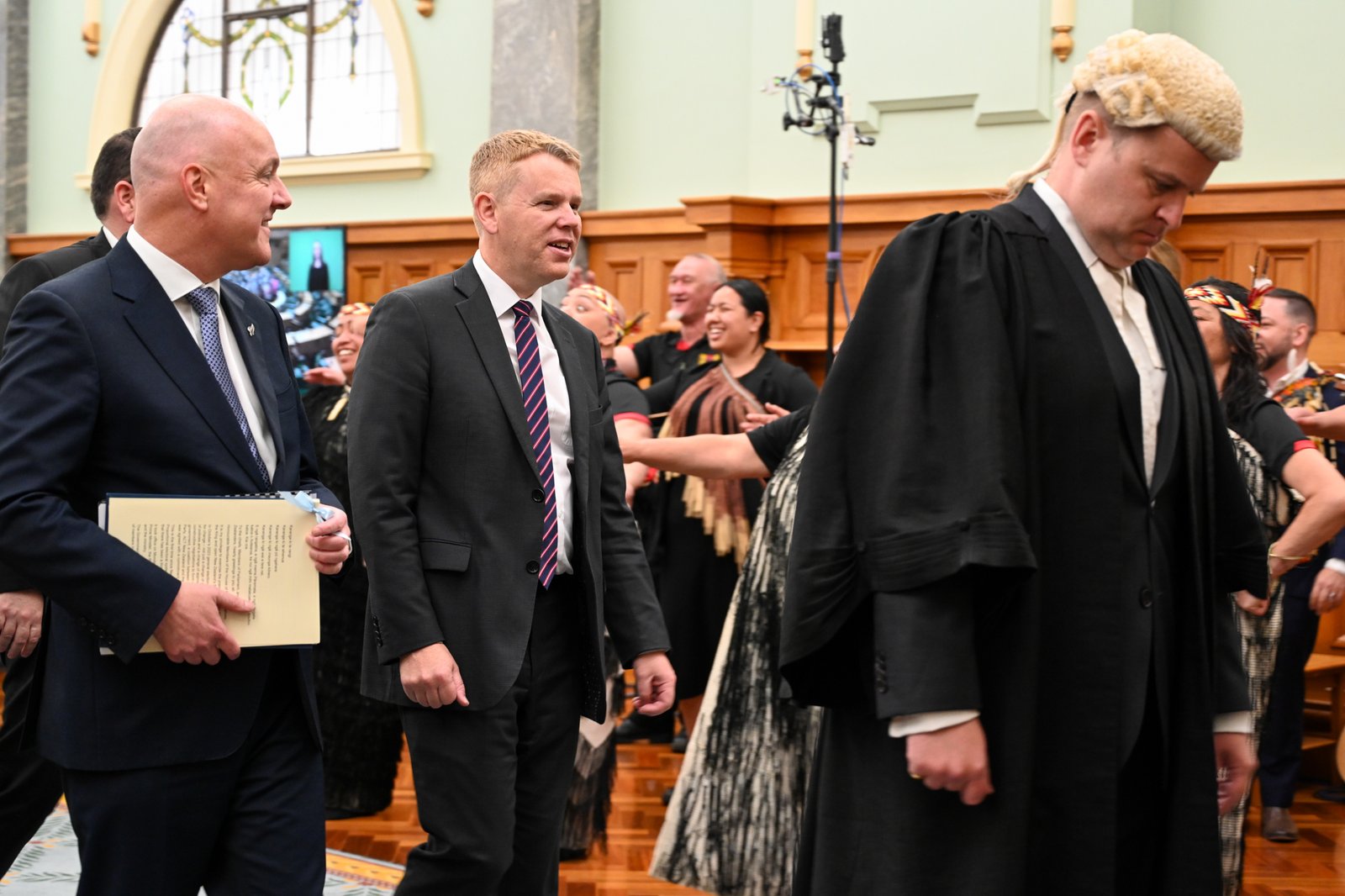
Prime Minister Christopher Luxon told supporters in Auckland that National was once again the largest party in parliament and had “a pathway to forming the next government”, but conceded the result was “too close to call”. Labour leader Chris Hipkins, who did not concede defeat, told supporters in Upper Hutt: “Tonight, New Zealand has spoken. It may take us a little bit longer to figure out exactly what it is that you’ve said.”
The result is a rebuke to both major parties. National’s share of the party vote fell to about 29.2 per cent, down from 38.1 per cent when it won power in 2023, while Labour also polled below 30 per cent. Voters instead boosted smaller parties on both flanks, and several of National’s most senior ministers, including Finance Minister Nicola Willis and Attorney-General Chris Bishop, looked set to lose their seats.
Until the official result, Mr Luxon will continue to lead a caretaker government, and coalition negotiations are expected to take weeks. The campaign was dominated by the cost of living and a struggling economy, and the final shape of the next government may not be known until after the special votes are counted.
Note: All figures in this story are preliminary results from New Zealand’s Electoral Commission and may shift when the official count, including special votes, is declared on 27 November.
Sources: Reuters, “New Zealand vote leaves National, Labour nearly deadlocked” (https://www.reuters.com/world/asia-pacific/new-zealand-vote-leaves-national-labour-nearly-deadlocked-2026-11-07/); CNN, “New Zealand in political limbo after knife-edge election” (https://www.cnn.com/2026/11/07/world/new-zealand-election-result-uncertain-intl-hnk?cid=external-feeds_iluminar_meta).