




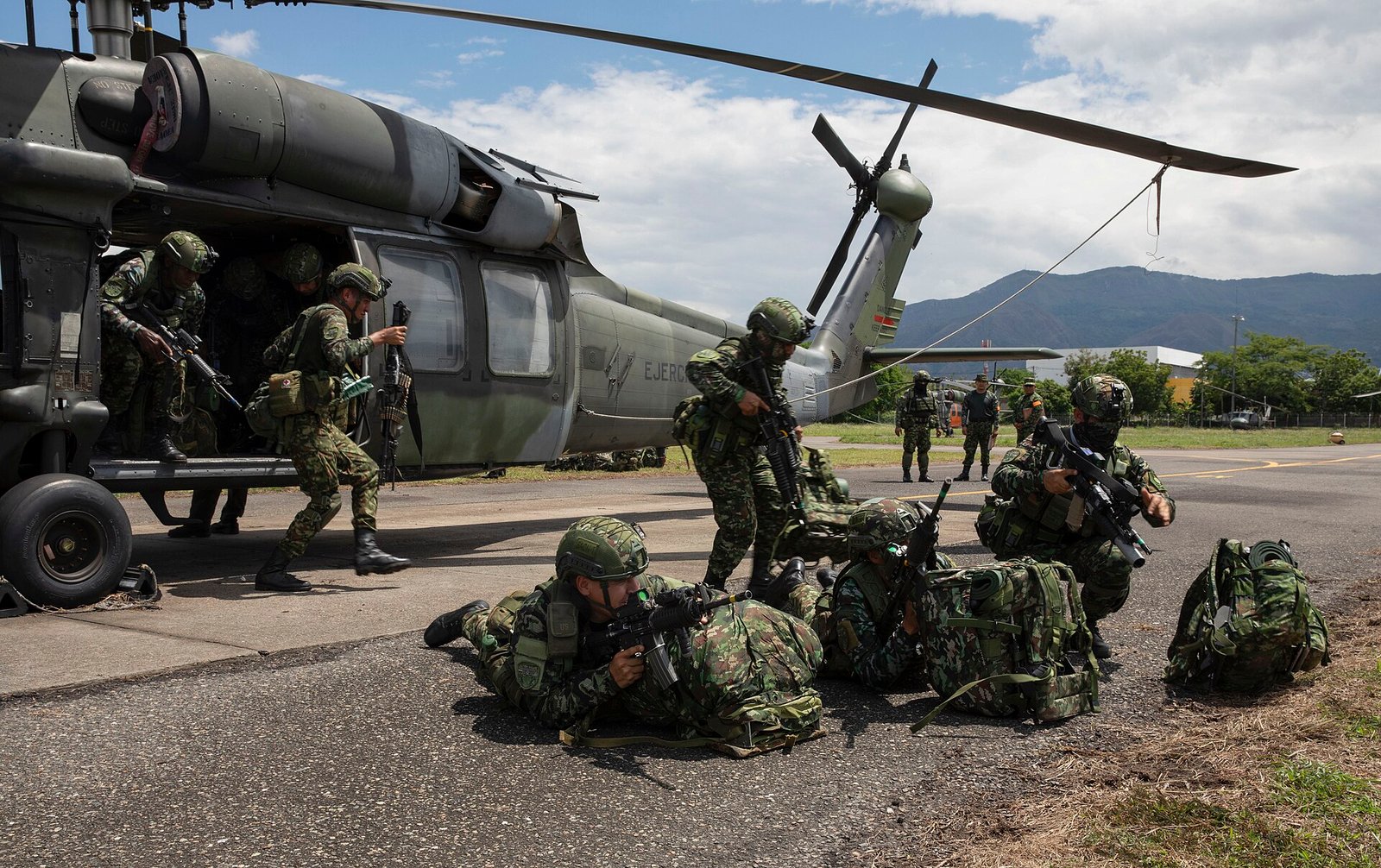
Drones fitted with explosives struck a Colombian Army base in the country’s north on Saturday, killing three soldiers and wounding at least 16, the armed forces said.
The attack hit the military compound at Santa Rosa del Sur, a small town in the foothills of the San Lucas mountain range in Bolívar department, which houses the army’s 48th Jungle Battalion. The military said in a statement on Saturday that the drones had been modified to carry explosive devices. Footage shared on social media, which has not been independently verified, showed smoke rising from the base after three explosions, with soldiers taking cover behind sandbag shelters.
The number of wounded has varied between reports. The army’s initial account referred to eight injured, while later reports citing the armed forces put the figure at at least 16. All reports agree that three soldiers were killed. The military had not released the names of the dead at the time of reporting.
No group has claimed responsibility, and the authorities have not said who carried out the attack. The area around Santa Rosa del Sur is rich in gold mines and has long been disputed by armed groups, including the Gulf Clan, the National Liberation Army (ELN) and smaller factions led by former fighters of the Revolutionary Armed Forces of Colombia (FARC).
President Abelardo de la Espriella, a conservative who took office in August, responded on X, saying those behind the attack would have “nowhere to hide” and that every attack against Colombian soldiers strengthens his government’s resolve to defend the country.
The strike is the latest in a series of attacks on security forces as violence rises across rural parts of the country. Officials said drone attacks with explosives in May this year killed one soldier and wounded four at the same base in Santa Rosa del Sur. Last week, a military base in Tolima province was hit by improvised missiles made from gas canisters, and four civilians, including a two-month-old baby, were killed, according to officials.
The attack is a test of de la Espriella’s hardline security policy. Since taking office he has cancelled peace talks with rebel groups and adopted a more confrontational approach, including more airstrikes, additional troops in some cities and joint task forces to protect an oil pipeline running from the Caribbean coast to central Colombia. His government argues that armed groups used ceasefires granted by the previous administration to tighten their control over rural areas, where they tax businesses and profit from the drug trade. Analysts and conflict monitors say violence has increased in rural areas since he took office.
A conflict-monitoring group recorded 34 bomb or explosive attacks involving state forces and armed groups in the four weeks to 16 October, a rise of 9 per cent over the same period last year.
Colombia’s 2016 peace agreement with the FARC led to the demobilisation of more than 14,000 fighters. Since then, smaller groups have fought over former rebel territory, and drone attacks on military installations have become a recurring feature of the conflict.
Sources: Associated Press; Al Jazeera; Colombian Army statement, 7 November 2026. Note: the casualty figures differ between the army’s initial account and later reports, and no group has been named as responsible; the account above relies on the Colombian armed forces’ statement as reported by the Associated Press and Al Jazeera.