








The two hottest years on record left a clear mark on the planet’s freshwater. A study published in the journal Science on Thursday found that global river discharge fell by about 5.7 per cent and the active water stored in lakes and reservoirs dropped by 9.5 per cent during 2023 and 2024, compared with the 1991–2020 average. The researchers describe the decline as abrupt and unprecedented in the 35-year record they examined.
The team, led by Yongqiang Zhang of the Chinese Academy of Sciences with Günter Blöschl of TU Wien in Vienna as senior author, analysed streamflow observations from 150 major river basins and satellite data covering more than 1.2 million lakes and reservoirs, reconstructing global water availability from 1991 to 2025. They found three phases: pronounced fluctuations from 1991 to 2006, relative stability from 2007 to 2022, then abrupt disruption in 2023 and 2024.
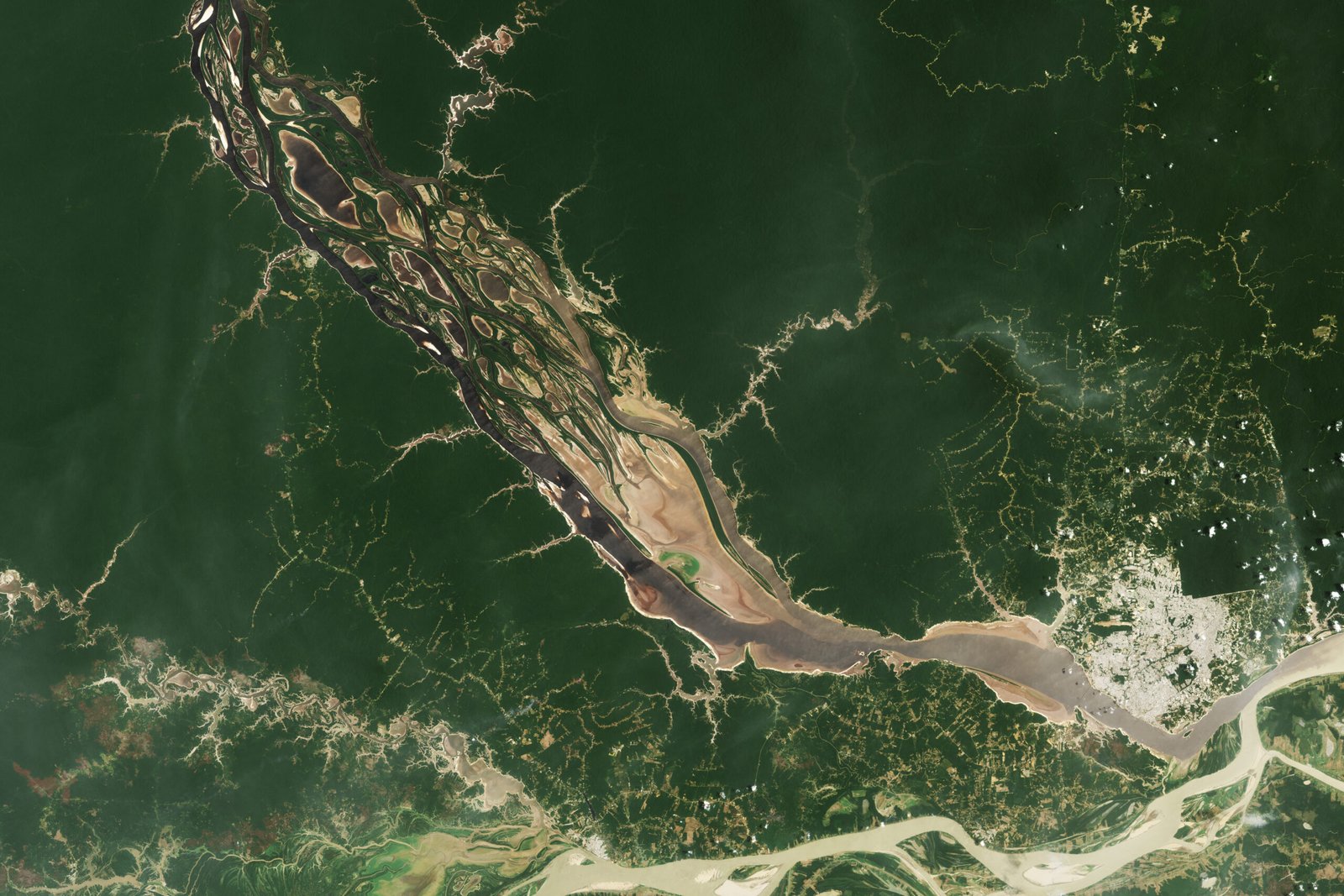
South America was hit hardest, accounting for about 70 per cent of the global decline in river flow. Streamflow there fell by 17.8 per cent and surface water storage by 16.5 per cent. The Amazon basin recorded its lowest flow in four decades, and the Rio Negro at Manaus fell to its lowest level since records began in October 2023. In the autumn of 2023, more than 200 pink river dolphins died at Lago Tefé in Brazil as drought combined with water temperatures above 40°C.
The cause was a rare combination of two warm oceans. A strong El Niño warmed the tropical Pacific while the tropical North Atlantic was unusually warm at the same time, altering large-scale atmospheric circulation so that air sank over South America and moisture was drawn away from the continent. “El Niño was the trigger, and the warm Atlantic was the amplifier,” Zhang said. The researchers also found that during El Niño peaks, the tropical Atlantic now warms about 1.2°C more for every 1°C of global warming, even though El Niño itself is not getting stronger — suggesting warming could make such droughts more likely.
The findings challenge a common assumption: that a warmer atmosphere, which can hold more water vapour, should mean more water on land. In 2023 and 2024 the atmosphere became wetter while the land became drier — land received about 1,360 cubic kilometres less rain per year than normal. Some regions still saw extreme rain and flooding; the decline is a global average, not a uniform fall everywhere.
There was a partial recovery: river flows began returning towards their long-term baselines in 2025, even though it was the third-hottest year on record. The researchers say the episode shows that surface freshwater is less stable than the calm two decades before it might have suggested, and that water security cannot be taken for granted even in humid regions. Note: the regional figures are the authors’ estimates from models and satellite data, not direct measurements of every river and lake.
Sources: Science, “Abrupt surface water decline during 2023–2024 record warming” (https://www.science.org/doi/10.1126/science.aei2575); TU Wien / Brightsurf release, “Extreme global heat triggered unprecedented decline in surface freshwater” (https://www.brightsurf.com/news/8OMXGQE1/extreme-global-heat-triggered-unprecedented-decline-in-surface-freshwater.html)