







The European Space Agency has released the first major collection of data from its Euclid space telescope, a haul covering more than 900 million galaxies that scientists hope will unlock the nature of dark matter and dark energy.
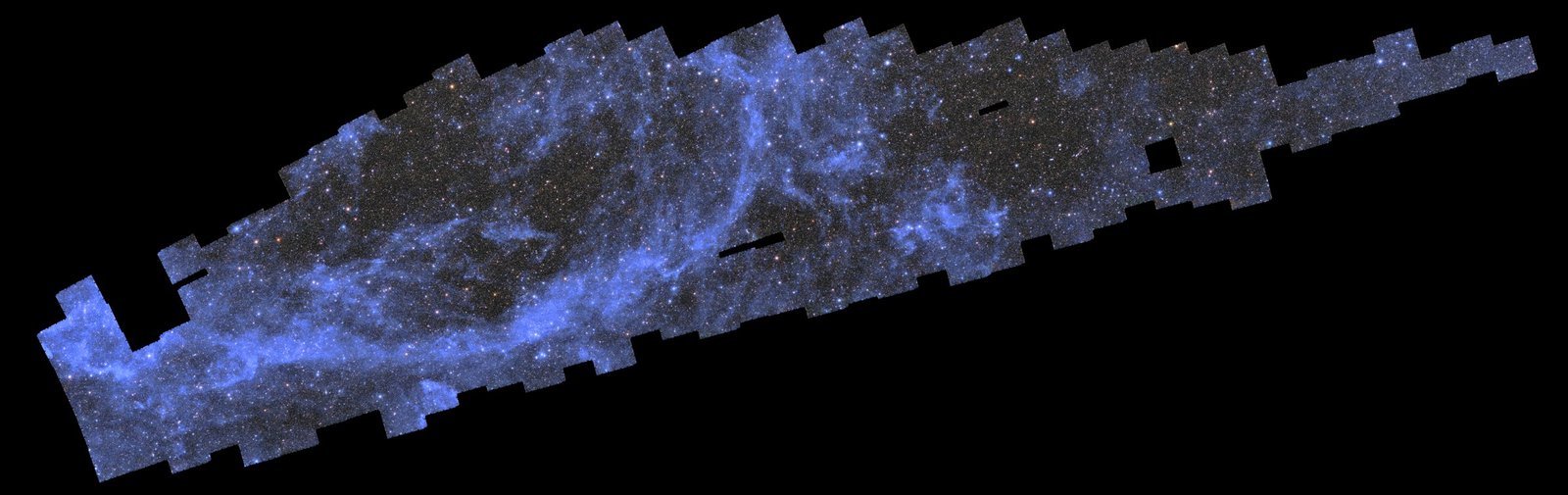
The data, unveiled on Thursday, covers a patch of sky equivalent to about 9,500 times the apparent size of the moon. It represents around 13 months of observations and totals 1.7 petabytes of data, or 1.7 million gigabytes.
Euclid, launched from Florida in 2023, is building the largest three-dimensional atlas of the cosmos ever attempted, spanning more than a third of the sky by the time the mission completes in 2031. The new release still covers only 14 per cent of the area the telescope is due to survey in visible and near-infrared light over six years.
“It marks a major milestone for ESA’s Euclid mission and for everyone involved,” said Valeria Pettorino, the agency’s Euclid project scientist.
Unlike earlier releases, which covered only a few days of observations, this dataset gives astronomers a year of data to work with. The first results on dark energy and dark matter are expected next year, when this data release is completed.
Euclid’s goal is to measure not just where galaxies appear in the sky, but how far away they are, adding the third dimension of distance and looking back across 10 billion years of cosmic history. Galaxies cluster along filaments separated by empty space, forming a network known as the cosmic web, and the way that web has grown over time depends on the properties of dark matter and dark energy.
Ordinary matter — stars, planets, gas and dust — makes up only about 5 per cent of the universe’s contents. Dark matter, known only from the gravitational pull it exerts on galactic scales, may account for about 27 per cent, while dark energy, thought to drive the accelerating expansion of the universe, may account for 68 per cent. Neither emits or absorbs light, and neither can be observed directly.
One of the sharpest tools in the new dataset is gravitational lensing, in which light from a distant galaxy is bent and distorted by matter in the foreground. The release contains about 15,000 strong gravitational lens candidates, more than the total discovered in the previous half century.
“Gravitational lenses are nature’s own weighing scales,” said Natalie Lines, a doctoral student in astrophysics at the University of Portsmouth and a member of the Euclid Consortium. “How strongly the light is bent tells us how much matter a galaxy contains, including invisible components like dark matter. With thousands of lenses, we can study how dark matter is spread through galaxies and understand how galaxies form and evolve over cosmic time.”
Euclid also pinpointed 60 million quasars, the brilliant cores of galaxies powered by supermassive black holes. Some date from when the universe was just 5 per cent of its current age, their light having set off around 13 billion years ago.
Ground-based telescopes can cover large areas of sky but are blurred by the atmosphere, while the Hubble and James Webb space telescopes take sharp images of only tiny patches. Euclid does both at once, Lines said, which is crucial for finding small and rare objects such as strong gravitational lenses.
Sources: Reuters — https://www.reuters.com/science/euclid-mission-data-release-spans-more-than-900-million-galaxies-2026-11-12/