








Astronomers have found the most distant quasar ever seen, a blazing galactic core powered by a black hole some 360 million times the mass of the Sun — already fully formed just 630 million years after the Big Bang.
The object, formally known as J1504+6252 and nicknamed Dún Aonghasa, was announced by the European Space Agency on Tuesday. It is the first quasar ever identified beyond a redshift of 8, at 8.13, meaning its light has travelled for roughly 13.1 billion years to reach us. The Universe was only about 5% of its current age when that light set out.
The discovery, published in the journal Astronomy and Astrophysics, breaks a record Euclid set itself only a few months ago. The previous record holder, found in July, dated to 670 million years after the Big Bang. Each of the two records before that had pushed the frontier back by about 15 million years or less; this one advances it by nearly 40 million years, the biggest leap in almost a decade.
Dún Aonghasa takes its name from a prehistoric stone fort perched on a cliff on Inis Mór, off Ireland’s Atlantic coast — a fitting namesake, the researchers said, for an object standing at the current observational frontier of the early Universe.
The quasar was picked out from millions of objects in about 18 months of data from Euclid’s wide survey of the sky. Its identity was then confirmed by an extensive follow-up campaign using the W. M. Keck Observatory, the Large Binocular Telescope, the Hubble Space Telescope and finally the James Webb Space Telescope, which measured the black hole’s mass.
What makes the find so puzzling is how such a monster could have grown so fast. Unlike other distant quasars, Dún Aonghasa is consuming material at a relatively slow rate today, so it must have reached its vast size in extremely rapid growth episodes very early in cosmic time. That puts pressure on existing models of how the first black holes formed and grew.
The researchers, led by astronomer Julien Wolf of the European Southern Observatory in Germany, calculated that the discovery is consistent with a “direct collapse” scenario, in which a massive cloud of gas condenses under its own gravity and forms a black hole directly, which then keeps accumulating matter. At about 360 million solar masses, the black hole is roughly 90 times more massive than the one at the centre of our own Milky Way.
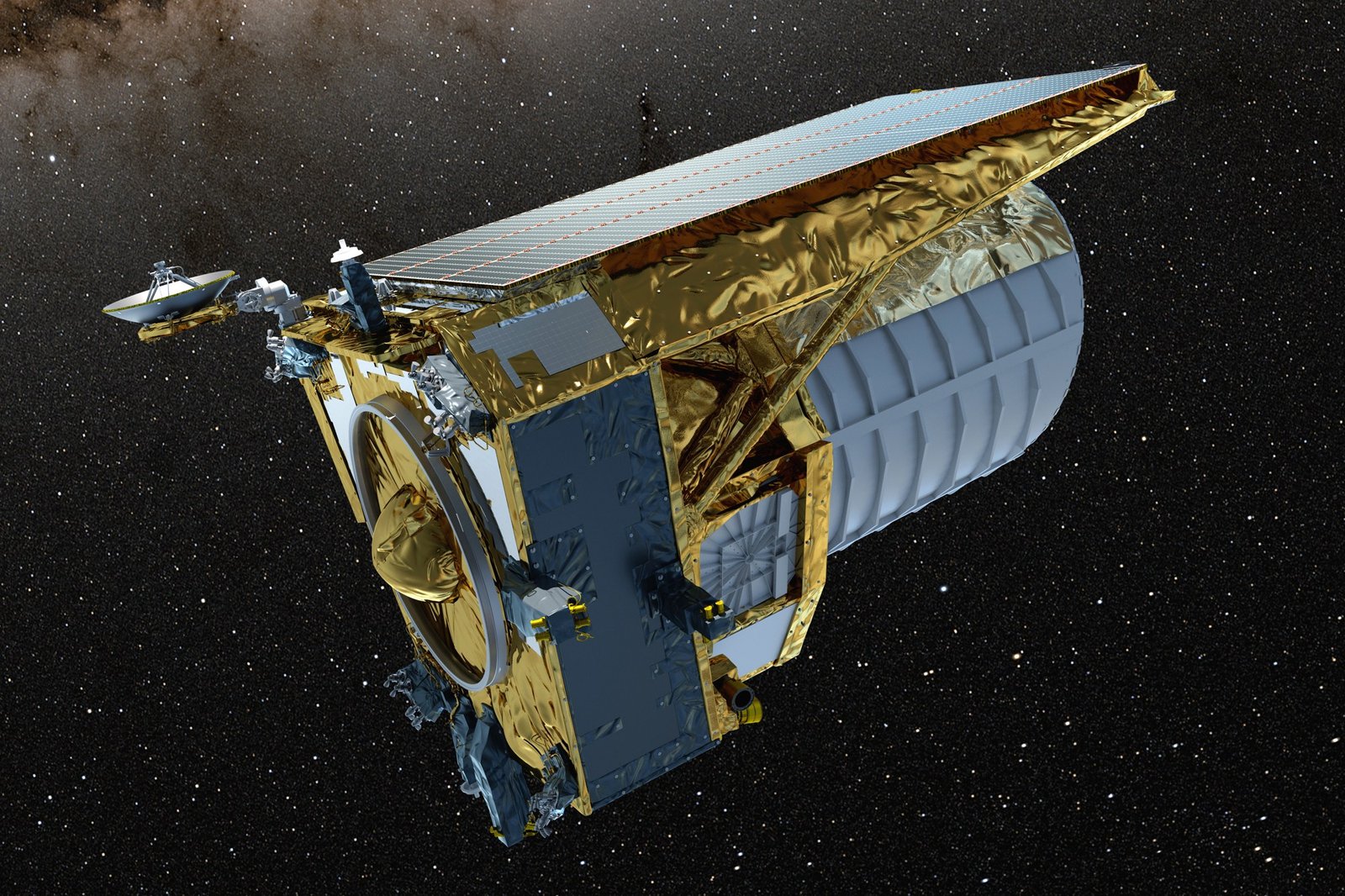
Euclid, launched in 2023 to map the dark Universe, has now flagged 31 quasars in barely a year and a half, 12 of them beyond redshift 7. Theoretical models suggest the first quasars could potentially date to between 270 million and 470 million years after the Big Bang, so still older ones may be waiting to be found. Wolf cautioned that the new record “could fall again in a few months or it could stand for years.”
Sources: Reuters, “Astronomers spot record-setting quasar in the early universe”, https://www.reuters.com/science/astronomers-spot-record-setting-quasar-early-universe-2026-11-24/ ; European Space Agency, “Euclid breaks own quasar record by 40 million years”, https://www.esa.int/articles/about-us/directorates/science/euclid/euclid-breaks-own-quasar-record-by-40-million-years