








Astronomers have finally explained why a giant star 30 million light-years from Earth keeps exploding without ever dying. The culprit, according to a new study, is a hidden companion — either a stellar-mass black hole or a neutron star — that pulls material from the star each time the two swing close together in their 113-day orbit.
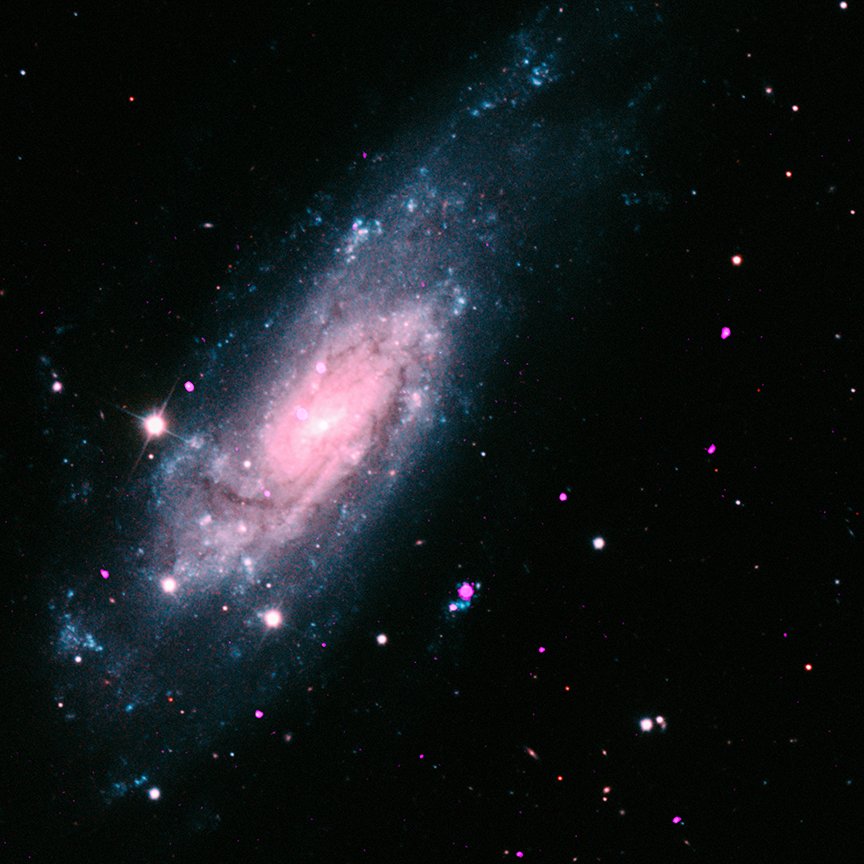
The star, known as AT 2016blu, sits in the spiral galaxy NGC 4559 and is at least 33 times as massive as the Sun. Between 2012 and 2026, astronomers recorded at least 27 bursts of visible light from it, roughly every 113 days. Each flare was so bright it resembled a supernova, the cataclysmic explosion that ends a massive star’s life. But AT 2016blu kept surviving, earning it the nickname of a “supernova impostor”.
“For 15 years, astronomers have been watching this star get really bright and then dim again on a regular basis,” said Mojgan Aghakhanloo of the University of Virginia, who led the study, published in The Astrophysical Journal. “Until we were able to get Chandra data at the right time, we couldn’t figure out what was making this happen.”
AT 2016blu is a luminous blue variable, a class of hot, massive stars known for dramatic changes in brightness — Eta Carinae is the best-known example. What sets this star apart is the speed and regularity of its outbursts, about three a year, which baffled researchers for more than a decade.
The breakthrough came from NASA’s Chandra X-ray Observatory, the only X-ray telescope with vision sharp enough to separate AT 2016blu from another bright X-ray source nearby. When ground-based telescopes spotted the star in outburst in early 2026, Chandra was quickly pointed at it under its Target of Opportunity programme. Data from March 2026 showed the star was at least 100 times brighter in X-rays than it had been in observations from 2001 and 2002, before the eruptions began.
The team’s explanation is that the two objects travel in an oval-shaped orbit. At their closest approach, gas ejected by the giant star is captured by its compact companion. The material whirls around the black hole or neutron star at close to the speed of light, growing so hot that it shines brightly in X-rays. Those X-rays then heat the dense gas surrounding the system, which glows in visible light — producing the flashes astronomers have watched since 2012.
It is the first time astronomers have detected X-rays from this class of erupting star, and the first time one has been found with a black hole or neutron star companion. AT 2016blu is also bright enough in X-rays to be classified as a candidate ultra-luminous X-ray source, a rare and still poorly understood category of object. The finding suggests a possible link between ultra-luminous X-ray sources and the violent eruptions seen in stars like this one.
The discovery may also help astronomers understand stars that brighten before they explode as supernovae. Researchers suspect much of that pre-explosion behaviour is caused by massive stars orbiting a compact object or another massive star. One key question remains open: the companion’s exact identity. The data cannot yet say whether it is a black hole or a neutron star, and further observations will be needed to tell them apart.
The optical monitoring that made the discovery possible relied on the Katzman Automatic Imaging Telescope, the Las Cumbres Observatory Global Supernova Project and the American Association of Variable Star Observers, including observations from more than 30 amateur astronomers.
Sources: NASA, “NASA’s Chandra Finds Source of Star’s Mysterious Outbursts”, https://science.nasa.gov/missions/chandra/nasas-chandra-finds-source-of-stars-mysterious-outbursts/ ; Chandra X-ray Center, “NASA’s Chandra Finds Source of Star’s Mysterious Outbursts”, https://chandra.harvard.edu/press/26_releases/press_110926.html