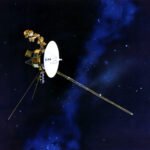








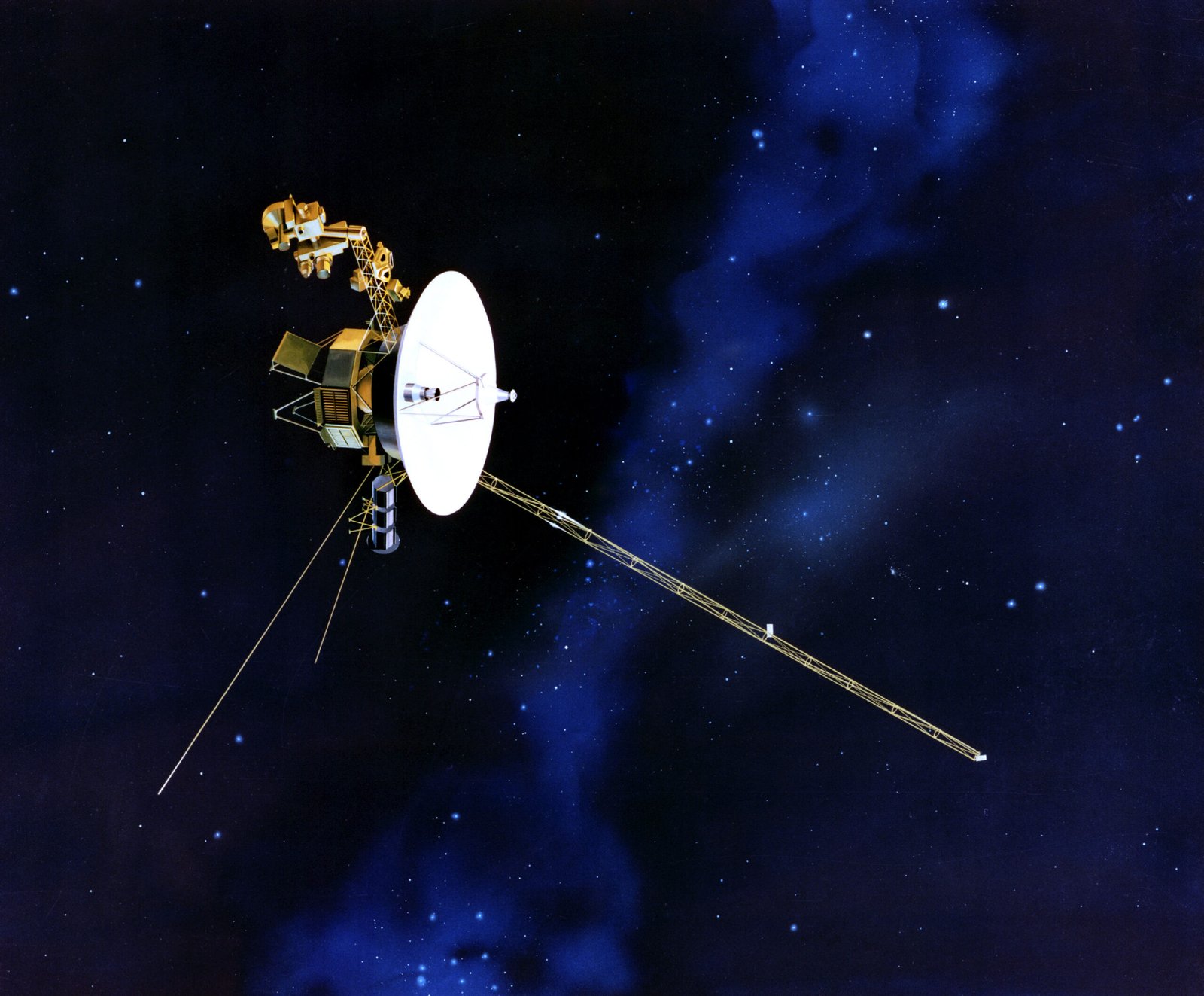
NASA’s Voyager 1 is about to set a record no human-made object has ever reached. On Wednesday, the spacecraft will sit one light-day from Earth — so far away that its radio signals will take a full 24 hours, travelling at the speed of light, to reach home.
Launched in September 1977, Voyager 1 has now travelled more than 16 billion miles (26 billion kilometres) from Earth, and it is still sending back science. It swept past Jupiter in 1979 and Saturn in 1980, then left the solar system altogether, crossing into interstellar space — the region between star systems — in 2012.
Almost every day, the probe beams back measurements of its never-before-explored surroundings: the strength and direction of the magnetic field, and details of the pressure, dust and galactic cosmic rays around it. “It’s a national treasure,” project manager Suzanne Dodd told The Associated Press. “Really extraordinary.”
Keeping a 49-year-old spacecraft alive takes constant care. A skeleton flight control team at NASA’s Jet Propulsion Laboratory in Pasadena, California, sends commands about once a week, with help sometimes coming from retirees who once worked on the mission. In September, controllers completed the latest power-conserving effort for the plutonium-powered spacecraft, and in October they briefly lost contact with it. They are still trying to work out why communication was disrupted.
Voyager 1’s twin, Voyager 2, launched two weeks earlier but took a slower route, visiting Uranus and Neptune as well as Jupiter and Saturn before entering interstellar space in 2018. It will not reach the one-light-day mark until 2035. Both craft are travelling at about 38,000 mph (61,000 kph) in different directions.
The spacecraft also carry one of humanity’s most famous messages. Each holds a 12-inch gold-plated phonographic record — the Golden Record — containing greetings in 55 languages, images and diagrams, including the voice of a six-year-old boy: “Hello from the children on planet Earth.” “It’s a time capsule of life on Earth from 1977,” Dodd said. “I hope something, someone, finds it maybe 1,000 years from now.”
Voyager 1 also took the most distant photograph of Earth ever made: the “Pale Blue Dot”, snapped from beyond Neptune in 1990. NASA puts the scale of the journey in perspective — it will take another 18,000 years for Voyager 1 to travel a full light-year, and more than twice that before it comes near another star.
To mark the milestone, NASA is urging people around the world to grab a phone or a flashlight after sunset on Tuesday and create a wave of golden light, using Morse code to spell out V-G-R, Voyager’s call sign, into the night sky.
Sources: The Associated Press (https://phys.org/news/2026-11-nasa-voyager-day-interstellar-space.html); NASA (https://www.nasa.gov/).