







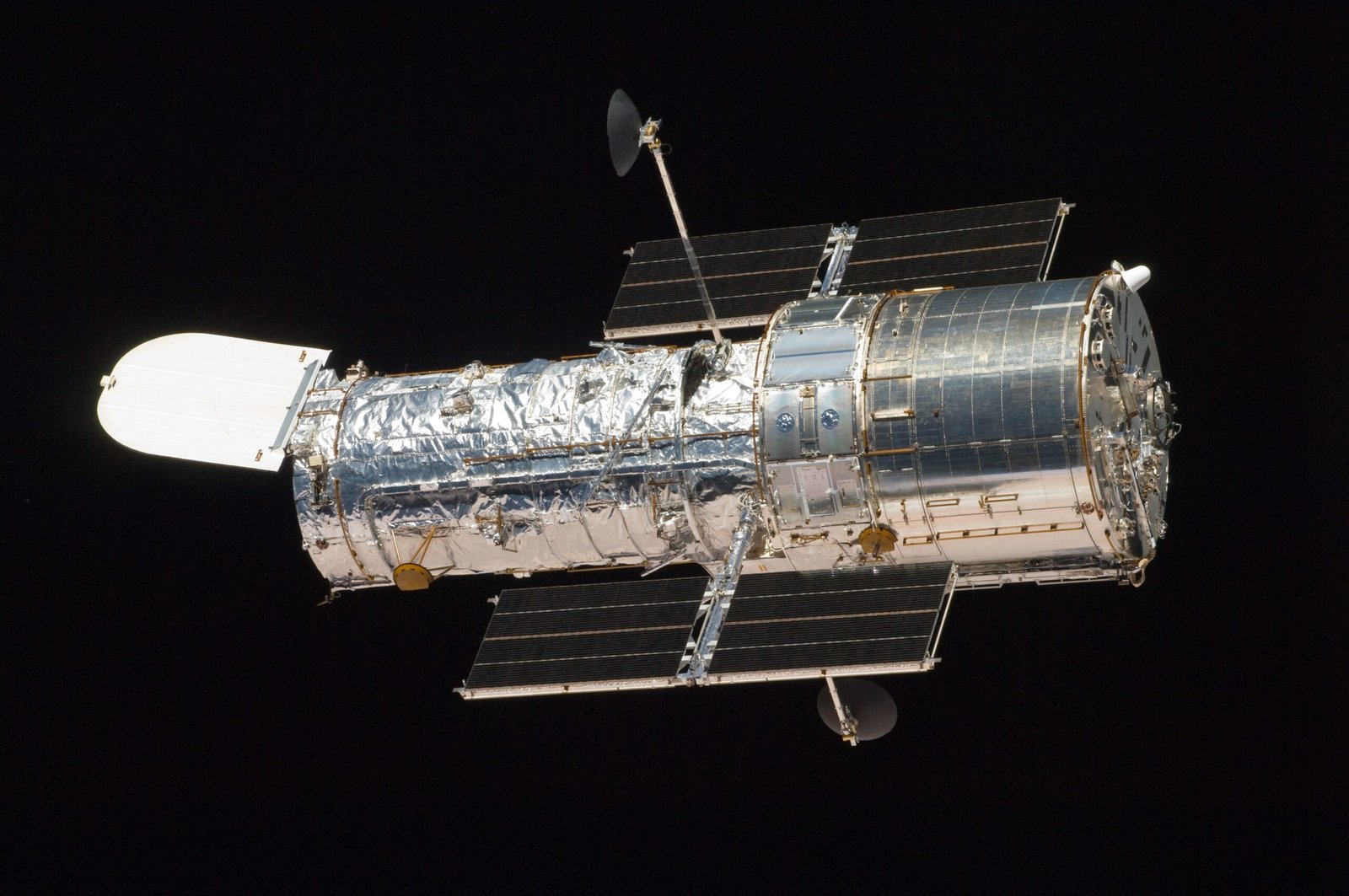
NASA has turned to private industry for ideas to save the Hubble Space Telescope, asking commercial companies to propose a mission that would lift the ageing observatory to a higher orbit, service it, or guide it safely back to Earth.
The agency issued a Request for Information on 29 October, inviting firms to set out what they could do with the telescope, which has been operating for more than 35 years. Responses are due by 3 p.m. Eastern time on Monday, 30 November.
The request sets out three possible paths. A company could capture Hubble in low Earth orbit and boost it to at least 600 kilometres, well above its current altitude, to extend its scientific life. It could fly a servicing mission to improve the telescope’s capabilities and resilience. Or it could carry out a controlled re-entry or orbital disposal when Hubble’s mission ends.
The clock is the reason for the urgency. Hubble has no propulsion system of its own, so atmospheric drag is slowly pulling it down. NASA’s analysis predicts the telescope is likely to re-enter the atmosphere in 2033 or 2034, and any rescue mission would therefore need to take place by 2032.
Hubble was launched in April 1990 and has fundamentally changed how humanity views the universe, from measuring the expansion of the cosmos to imaging distant galaxies in unprecedented detail. Astronauts last serviced it in 2009, during the final space shuttle servicing mission, and the shuttle fleet has since retired, leaving NASA without its own vehicle for such a visit.
“Hubble still has important science ahead of it, and we should be looking at every reasonable opportunity to keep it delivering for as long as possible,” NASA Administrator Jared Isaacman said. He added that if there were innovative and cost-effective ways to extend the life of an asset already in orbit, the agency owed it to taxpayers and the scientific community to explore them.
Nicky Fox, NASA’s associate administrator for science, said commercial industry had rapidly developed new capabilities for capturing and servicing satellites in orbit, and that NASA was eager to explore the breadth of possibilities for boosting Hubble higher while it develops the flagship mission to follow it.
The request is exploratory, not a contract. It does not commit NASA to a mission, a company, or a price, and any firm that responds would be expected to supply its own launch vehicle, spacecraft, mission operations and crew if needed, with NASA’s Goddard Space Flight Center providing technical information and coordination. A formal competition could follow, but none has been announced.
Hubble is a joint project of NASA and the European Space Agency. Goddard, in Maryland, manages the telescope and its operations, while the Space Telescope Science Institute in Baltimore runs its science programme. For now, the telescope continues to observe, but the request makes clear that its future will depend on whether industry can offer a safe, affordable way to keep it up there — or, failing that, to bring it down in a controlled way.
Sources: NASA, “NASA Explores Potential Commercial Servicing for Hubble Telescope”, 30 October 2026, https://science.nasa.gov/missions/hubble/nasa-explores-potential-commercial-servicing-for-hubble-telescope/