








Glasgow’s leaner Commonwealth Games generated £223 million in economic activity across Scotland, according to an evaluation commissioned by the organisers and published on Monday.
The 11-day event, staged in the Scottish city earlier this year, produced £158.6 million of that total for the Glasgow City Region alone, the evaluation found. The headline figure is measured as gross output, a broad measure of economic activity rather than profit or a direct return to public funds.
The result matters because Glasgow 2026 was deliberately designed to be smaller. The city, which had previously hosted the Games in 2014, stepped in after two earlier hosts pulled out, and staged a competition featuring 10 sports rather than the 17 to 20 seen in previous editions. Organisers said the approach relied on existing venues, experienced staff and local communities, rather than large new building programmes.
That restraint showed up in the bill. Organisers put the cost of staging Glasgow 2026 at £160 million, far below the £944 million spent on the 2022 edition in Birmingham. The Glasgow event was funded by compensation paid by the Australian state of Victoria after it withdrew as host in 2023, together with funding from the Commonwealth Games Federation.
Commonwealth Sport chief executive Katie Sadleir said the evaluation showed the value of shaping a Games around what a host already has, and argued that Glasgow’s experience offered a blueprint for other nations and territories to adapt future Games to their own strengths, communities and ambitions. She also said the findings supported the organisation’s wider reset, aimed at protecting the quality of integrated sport while allowing more flexible approaches to hosting.
The Games themselves have faced questions about their future relevance. As a quadrennial event for mainly former British colonies, the Commonwealth Games have struggled in recent years to attract hosts willing to take on the cost and scale of a traditional multi-sport festival. Glasgow’s model was therefore watched closely as a test of whether a smaller, cheaper version could still deliver a major event and a measurable economic return.
The evaluation does not settle every question. It was commissioned by the organisers, even though it is described as independent, and gross output is not the same as net benefit: it does not, on its own, show how much of the activity would have happened anyway, or what the longer-term legacy for venues, jobs and participation will be. Those are the measures against which the reset will ultimately be judged.
For now, though, the figures give the organisers a clear argument to take to future hosts: a Games built around existing facilities can still generate substantial activity, at a fraction of the cost of recent editions. The next test of that argument will come in 2030, when the Games move to Ahmedabad in western India.
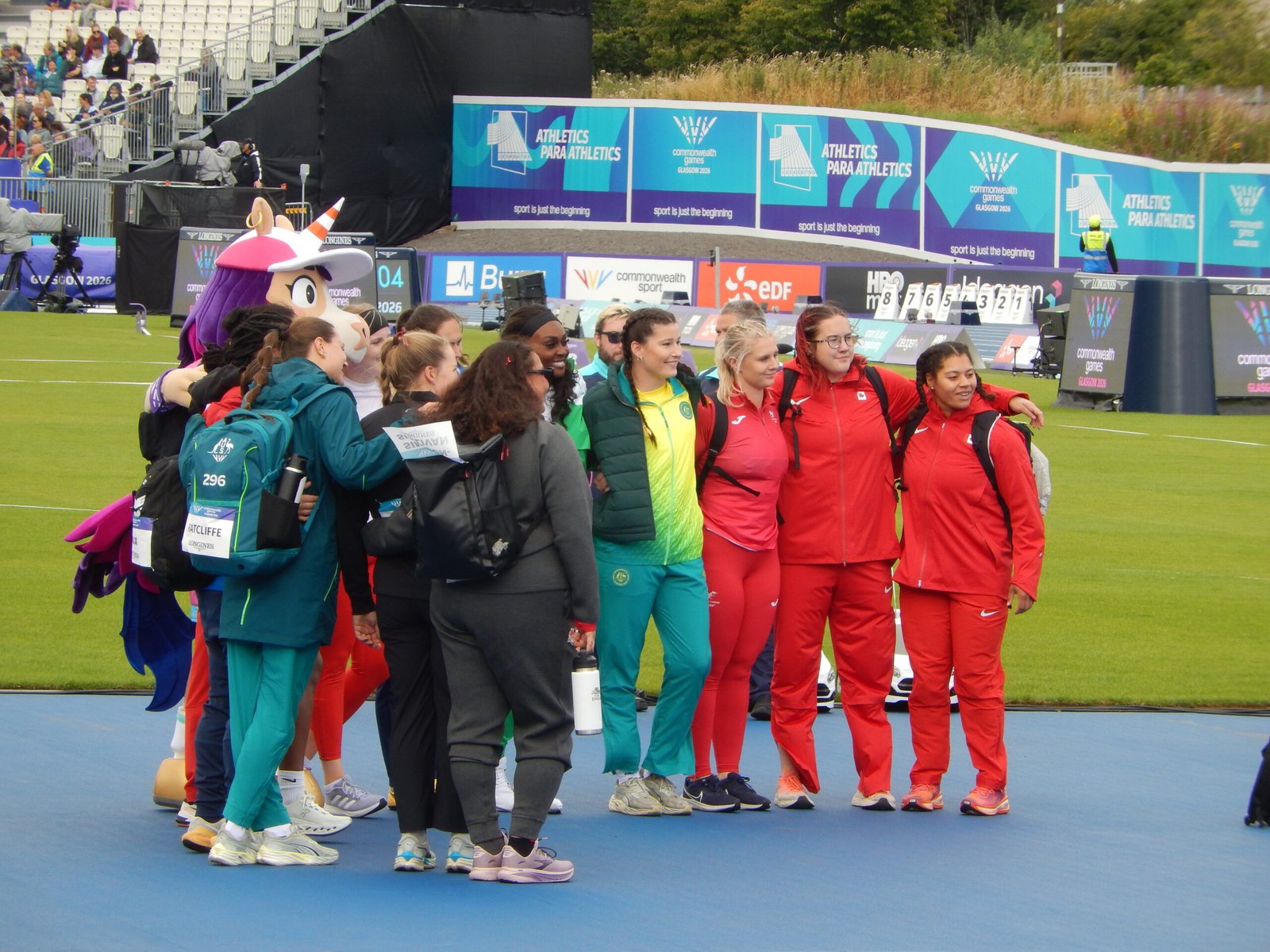
Note: the featured image is a file photo of women’s hammer throw competitors with Finnie, the Glasgow 2026 mascot, on the first morning of athletics at Scotstoun Stadium, not a photograph of the evaluation announcement.
Sources: Reuters, “Leaner Commonwealth Games generated £223 million in economic activity across Scotland, evaluation shows”, 2 November 2026, https://www.reuters.com/sports/leaner-commonwealth-games-generated-223-million-economic-activity-across-2026-11-02/