






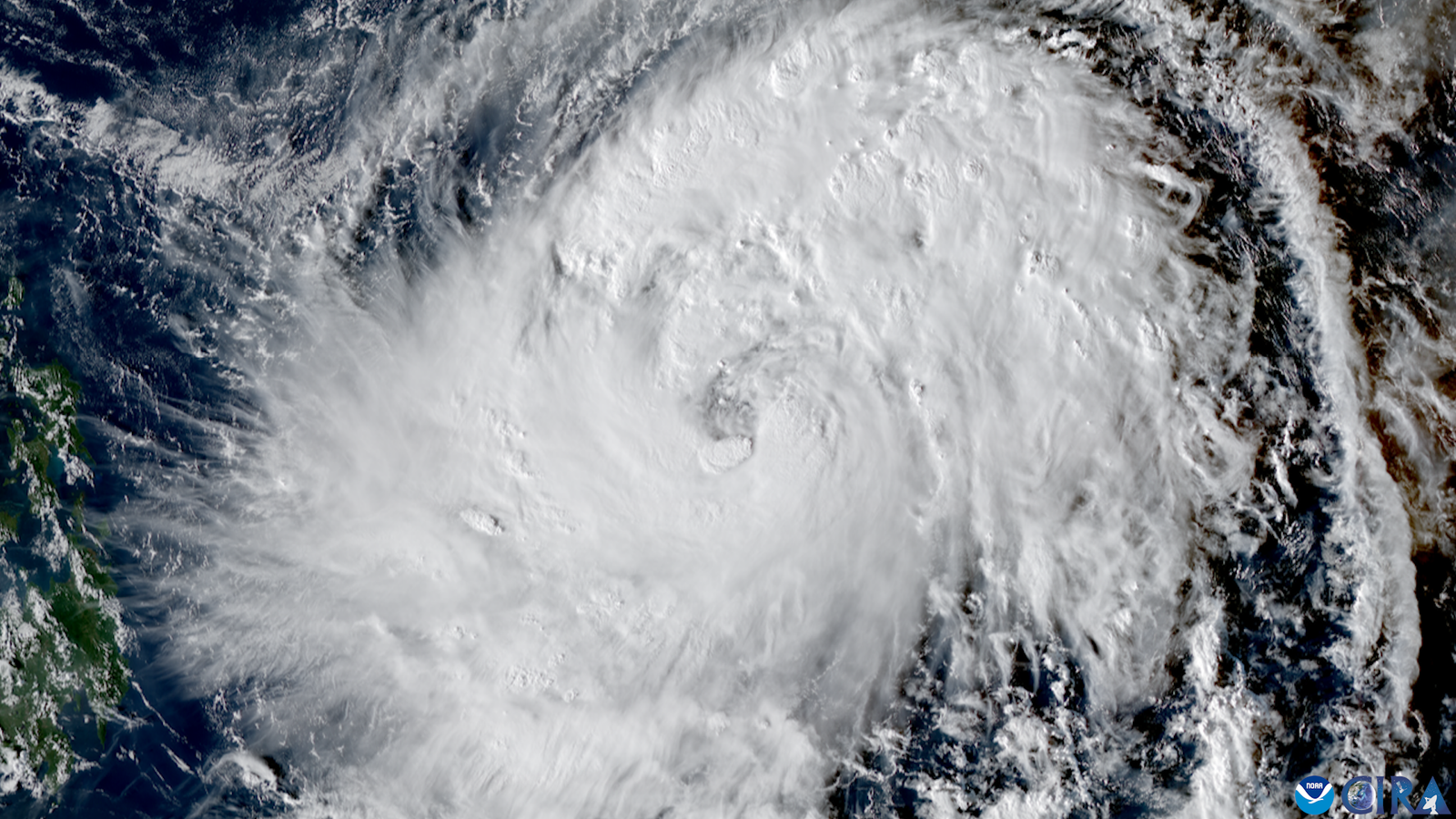
Super Typhoon Fung-wong is bearing down on the Philippines after nearly a million people were moved out of high-risk villages, as the country braces for the biggest storm of the year only days after a typhoon killed more than 220 people.
Known locally as Uwan, the storm was spotted by government forecasters before noon on Sunday over coastal waters near the town of Pandan in eastern Catanduanes province, with sustained winds of up to 185 kilometres per hour and gusts of up to 230 kilometres per hour. Forecasters expect it to make landfall on the coast of Aurora or Isabela province later on Sunday or early on Monday.
More than 916,860 people have been evacuated from high-risk villages in northeastern provinces, including Bicol, a coastal region vulnerable to Pacific cyclones and mudflows from Mayon, one of the country’s most active volcanoes. The Office of Civil Defense said more than 30 million people could be exposed to hazards from the storm, whose rain and wind band spans about 1,600 kilometres, enough to cover two-thirds of the archipelago.
Authorities have warned of a high risk of life-threatening storm surges of more than three metres along the coasts of more than 20 provinces and regions, including metropolitan Manila. Schools and most government offices in northern provinces have been ordered shut on Monday and Tuesday, at least 325 domestic and 61 international flights have been cancelled, and more than 6,600 commuters and cargo workers were stranded at 109 seaports after the coast guard barred ships from rough seas.
Defence Secretary Gilberto Teodoro Jr, who oversees the country’s disaster response agencies and the military, warned in televised remarks on Saturday of the storm’s potentially catastrophic impact and urged people in areas prone to flash floods, landslides and coastal surges to move immediately. “We need to do this because when it’s already raining or the typhoon has hit and flooding has started, it’s hard to rescue people,” he said.
President Ferdinand Marcos Jr has declared a state of emergency because of the devastation caused by Typhoon Kalmaegi and the calamity expected from Fung-wong. Kalmaegi struck central island provinces on Tuesday, killing at least 224 people, before moving on to Vietnam, where at least five were killed. The Philippines has not called for international help, but Teodoro said the United States and Japan were ready to provide assistance.
Forecasters at the World Meteorological Centre Beijing said the typhoon, then about 1,240 kilometres east of Manila, was moving west at 30 to 35 kilometres per hour and was expected to cross Luzon and enter the South China Sea on 10 November. Much of the country faces severe rain and wind from 8 to 11 November, with some areas expected to receive more than 300 millimetres of rain.
Fung-wong is the 21st tropical cyclone to hit the Philippines this year, above the annual average of 20. The country is battered by about 20 typhoons and storms a year, and is among the world’s most disaster-prone nations.
Sources: Associated Press (https://www.northcountrypublicradio.org/news/npr/g-s1-97091/nearly-a-million-people-evacuate-as-super-typhoon-fung-wong-threatens-the-philippines); World Meteorological Centre Beijing / China Meteorological Administration (https://www.cma.gov.cn/en/forecast/news/202511/t20251111_7438205.html)