








Rain, not wind, appears to be the main force breaking apart the vast sheets of bright cloud that shade Earth’s oceans and help keep the planet cool, according to new observations from the European Space Agency’s EarthCARE satellite.
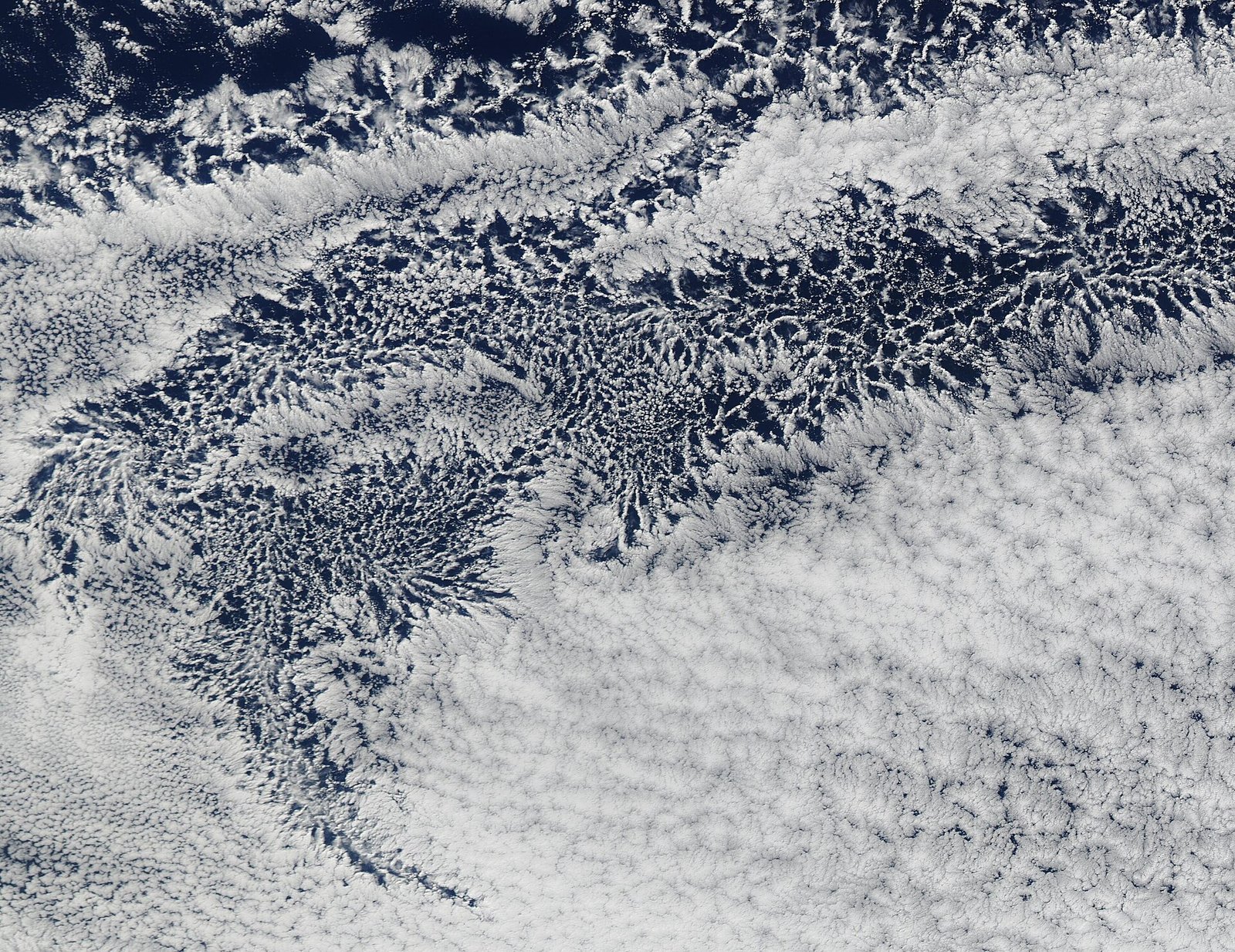
Marine stratocumulus clouds are low, highly reflective decks that stretch across huge areas of the world’s oceans, most prominently off the western coasts of North and South America and southern Africa. Acting as one of Earth’s most effective natural sunshades, they bounce large amounts of incoming sunlight back into space. But when a continuous deck breaks up, more of the dark ocean surface is exposed, absorbing far more solar energy instead.
That matters because Earth is already reflecting less sunlight back into space than it once did, leaving more solar energy retained within the climate system. The resulting energy imbalance is greater than climate models had predicted, and recent studies have found that marine stratocumulus clouds are declining — one of the causes of the reduction in reflected sunlight. Until now, scientists have not fully understood why.
The new findings, published in the journal Atmospheric Chemistry and Physics and announced by ESA on 19 November, come from a team led by Johanna Mayer, a research fellow at ESA’s Earth System Science Hub. The researchers combined two very different views of the clouds from space: images from a geostationary satellite, which tracked how individual cloud fields evolved over time, and EarthCARE, which provided detailed snapshots of the clouds’ internal structure, droplet sizes and rainfall.
The observations point to rain as a key driver of the transition from a continuous, closed-cell cloud deck to a more fragmented open-cell pattern. As clouds begin to produce rain, falling raindrops remove aerosol particles from the air — the tiny particles that provide the surfaces on which cloud droplets form. With fewer particles available, the remaining droplets grow larger, making further rainfall more likely and intensifying the process. Eventually, the feedback can disrupt the air circulation that helps maintain the continuous deck, causing it to break apart into distinctive open-cell patterns with clear gaps between cloud patches.
The data show the process building well before the breakup itself: liquid water content and rain amounts inside closed-cell cloud fields climbed for up to 25 hours before a transition began, while droplet numbers fell and average droplet size grew, even though the clouds’ overall vertical structure changed comparatively little.
The results support a self-reinforcing cycle long predicted by cloud physics theory but rarely documented so clearly from orbit. EarthCARE, launched in May 2024, is the first satellite to combine a cloud-profiling radar — the first Doppler radar flown in space — with a lidar and a multispectral imager, allowing it to probe the vertical structure of clouds in a way earlier missions could not.
Understanding why bright marine stratocumulus decks break up is an important step towards explaining their observed decline and improving predictions of how they may respond as the planet continues to warm. Bjorn Stevens, director of the Max Planck Institute for Meteorology, said that applying the techniques developed by Dr Mayer to the growing body of EarthCARE measurements should help scientists better understand the processes governing Earth’s energy budget and, in turn, the rate of global warming.
The findings explain one mechanism behind the clouds’ decline, but they do not by themselves settle whether the trend will continue or accelerate as the planet warms — a question the researchers say still needs more data from the mission.
Sources: European Space Agency, “Rain breaks up Earth’s natural sunshades” (https://www.esa.int/articles/about-us/directorates/earth-observation-programmes/futureeo/earthcare/rain-breaks-up-earth-s-natural-sunshades); Mayer et al., Atmospheric Chemistry and Physics.