









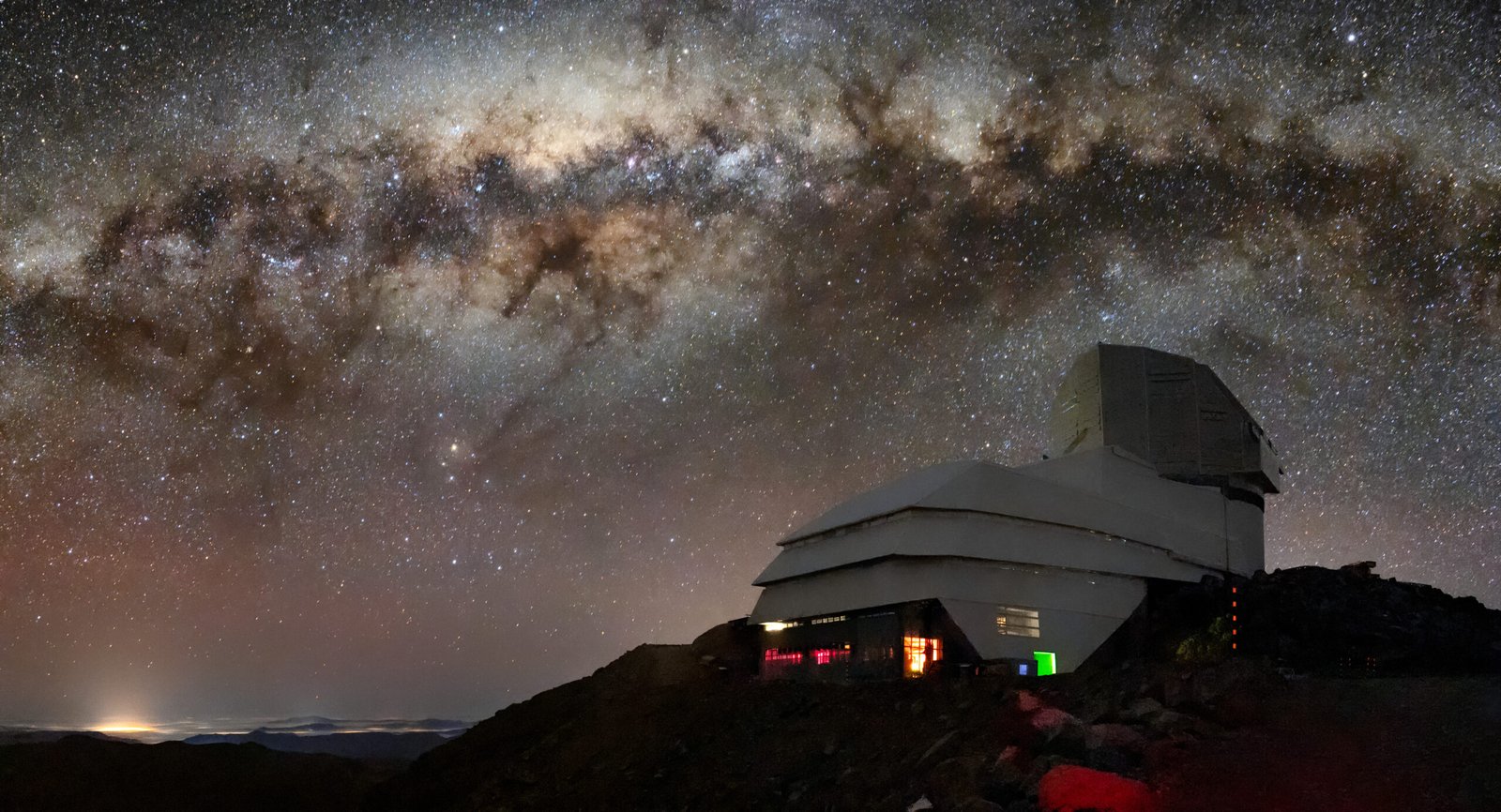
Astronomers working with the Vera C. Rubin Observatory in Chile have identified a large object orbiting the Sun beyond Pluto that could become the Solar System’s sixth officially recognised dwarf planet. The candidate, given the provisional designation 2026 ED138, was announced by the International Astronomical Union’s Minor Planet Center on 27 October.
The discovery was made by Matthew Holman of the Center for Astrophysics | Harvard & Smithsonian, who found the object on 13 October while running a search algorithm over Rubin observations taken earlier in 2026. Rubin’s Simonyi Survey Telescope had recorded the object 30 times on 20 nights between 4 March and 11 July 2026. Further digging then traced it in archival images from the Dark Energy Camera going back to 2016 — a decade in which the object sat unnoticed in existing data.
ED138 is currently about 46 astronomical units from the Sun, roughly 46 times the Earth-Sun distance and well beyond Neptune’s orbit, placing it in the Kuiper Belt, the doughnut-shaped region of icy bodies at the Solar System’s edge. Its full orbit takes about 281 years, ranging from about 37 astronomical units at its closest approach to the Sun to about 49 at its farthest.
Preliminary analysis puts the object at between 600 and 1,500 kilometres across, which would place it in the size class of the dwarf planets Makemake and Haumea. That estimate, however, is not yet settled: it rests on the object’s brightness, its distance and an assumed surface reflectivity. Icy bodies this large are expected to be pulled into a round shape by their own gravity, and roundness is the key test for dwarf-planet status — but confirming the size will require infrared observations, which measure the heat the object gives off and so reveal how reflective its surface really is. No infrared follow-up has yet been scheduled, and until then ED138 remains a candidate, not a confirmed dwarf planet.
If confirmed, ED138 would join just five worlds formally recognised as dwarf planets by the International Astronomical Union: Pluto, Ceres, Eris, Haumea and Makemake. It would be only the second new dwarf planet to earn formal recognition since 2008, and the first dwarf-planet candidate reported by Rubin Observatory, which is still in the run-up to its ten-year Legacy Survey of Space and Time. Astronomers expect that survey to uncover tens of thousands of new objects in the Kuiper Belt, and ED138 is an early sign of what it may find.
Note on sourcing: the size range for ED138 is a preliminary estimate based on assumed reflectivity, and its status as a dwarf planet is unconfirmed pending infrared observations; the discovery itself and the observation record are confirmed by the Minor Planet Center announcement and the NOIRLab release.
Sources: NSF NOIRLab, “NSF–DOE Vera C. Rubin Observatory Reveals Its First Dwarf Planet Candidate in Our Solar System”, https://www.noirlab.edu/public/news/noirlab2626/