








SpaceX’s Starship reached orbit on Friday in the company’s most ambitious test flight yet, but the attempt to recover the whole rocket in one go ended when the giant booster was diverted into the Gulf of Mexico and exploded.
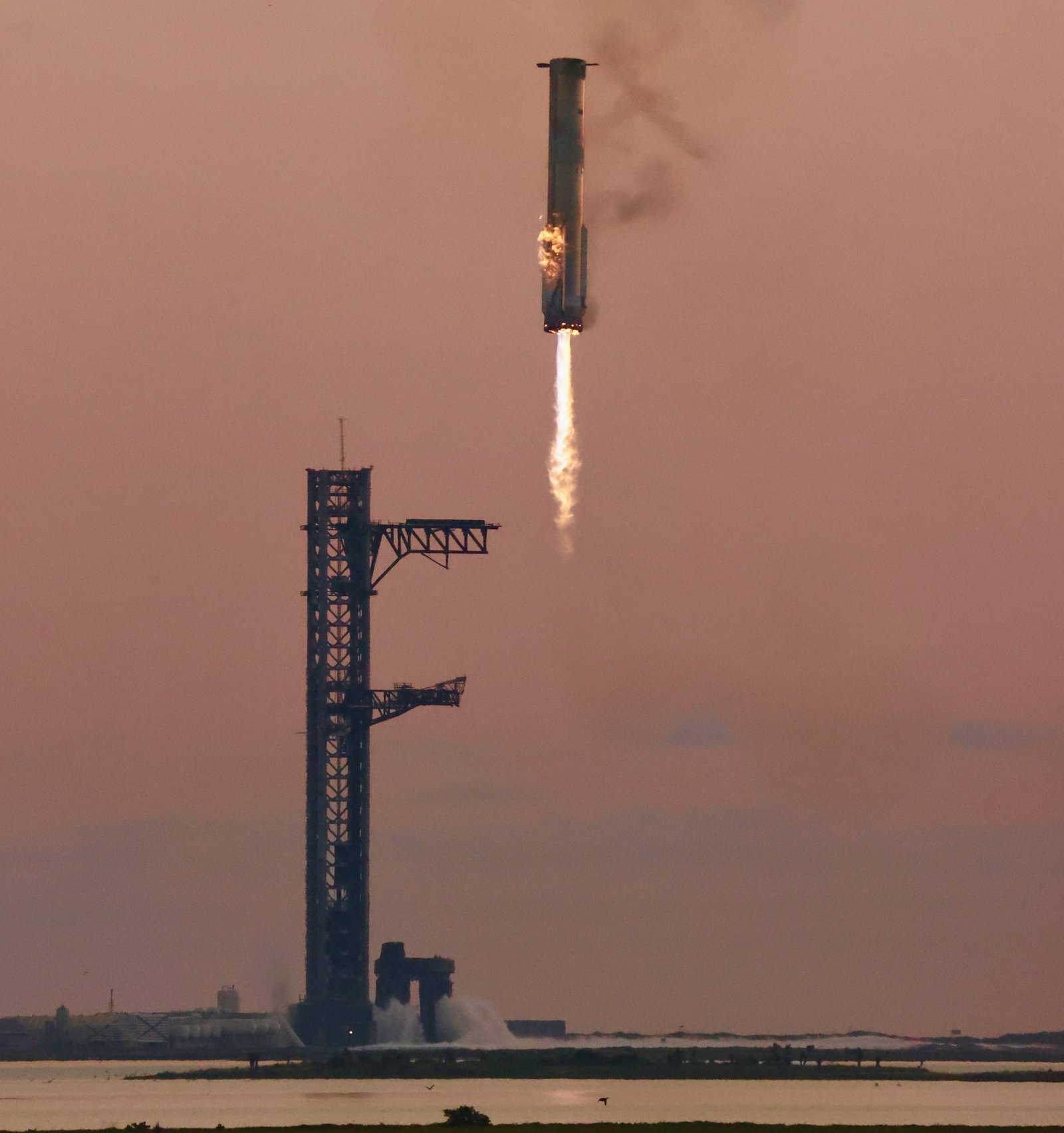
Flight 15 lifted off from Starbase in South Texas at 5.47pm Eastern time on Friday. Minutes after liftoff, flight controllers aborted the planned catch of the 236-foot Super Heavy booster by the launch tower’s mechanical arms, sending it to a splashdown offshore instead. It burst into flames as it came down. SpaceX has not said what triggered the abort.
The setback did not stop the mission. The bullet-shaped spacecraft continued into orbit — only the second time a Starship has done so — and deployed 26 of SpaceX’s latest Starlink satellites shortly after reaching orbit. The flight is planned to last up to 22 hours, with the spacecraft circling Earth 15 times at an altitude of about 170 miles (275 kilometres) before attempting to return to the pad on Saturday afternoon, the first time SpaceX has tried to catch a spacecraft returning from orbit.
The double catch was the point of the flight. SpaceX has already caught three boosters with the tower’s “chopsticks”, but recovering both stages is the key to the fully reusable rocket that Elon Musk wants for moon bases and missions to Mars. Together, the booster and spacecraft stand 407 feet (124 metres), the largest and most powerful rocket ever flown. This was the first attempt to catch the upgraded Version 3 booster, the production model intended for moon and Mars expeditions.
The stakes go beyond SpaceX. NASA is paying the company billions of dollars to land Artemis astronauts on the moon using Starship, and NASA Administrator Jared Isaacman welcomed the orbital success on X. NASA expects to decide a year before the Artemis IV landing — the first by astronauts in more than half a century — whether Starship or Blue Origin’s Blue Moon will carry moonwalkers to the surface, with a touchdown possible as early as 2028. During next summer’s Artemis III mission, astronauts will practise docking with both vehicles in Earth orbit.
This account of the abort rests on the Associated Press’s reporting of the flight: SpaceX has given no explanation for the diversion, and Saturday’s catch attempt depends on the spacecraft’s condition. SpaceX also plans to start launching Starships from Florida within a few months and from Louisiana in a few years.
Sources: Associated Press (https://listenupyall.com/2026/11/13/spacex-aims-for-first-double-catch-of-starship-in-its-most-ambitious-test-flight-yet/); Spaceflight Now (https://spaceflightnow.com/2026/11/13/live-coverage-starship-flight-15-attempts-to-recover-full-vehicle-in-double-launch-pad-catch/); SpaceX (https://www.spacex.com/launches/starship-flight-15)