








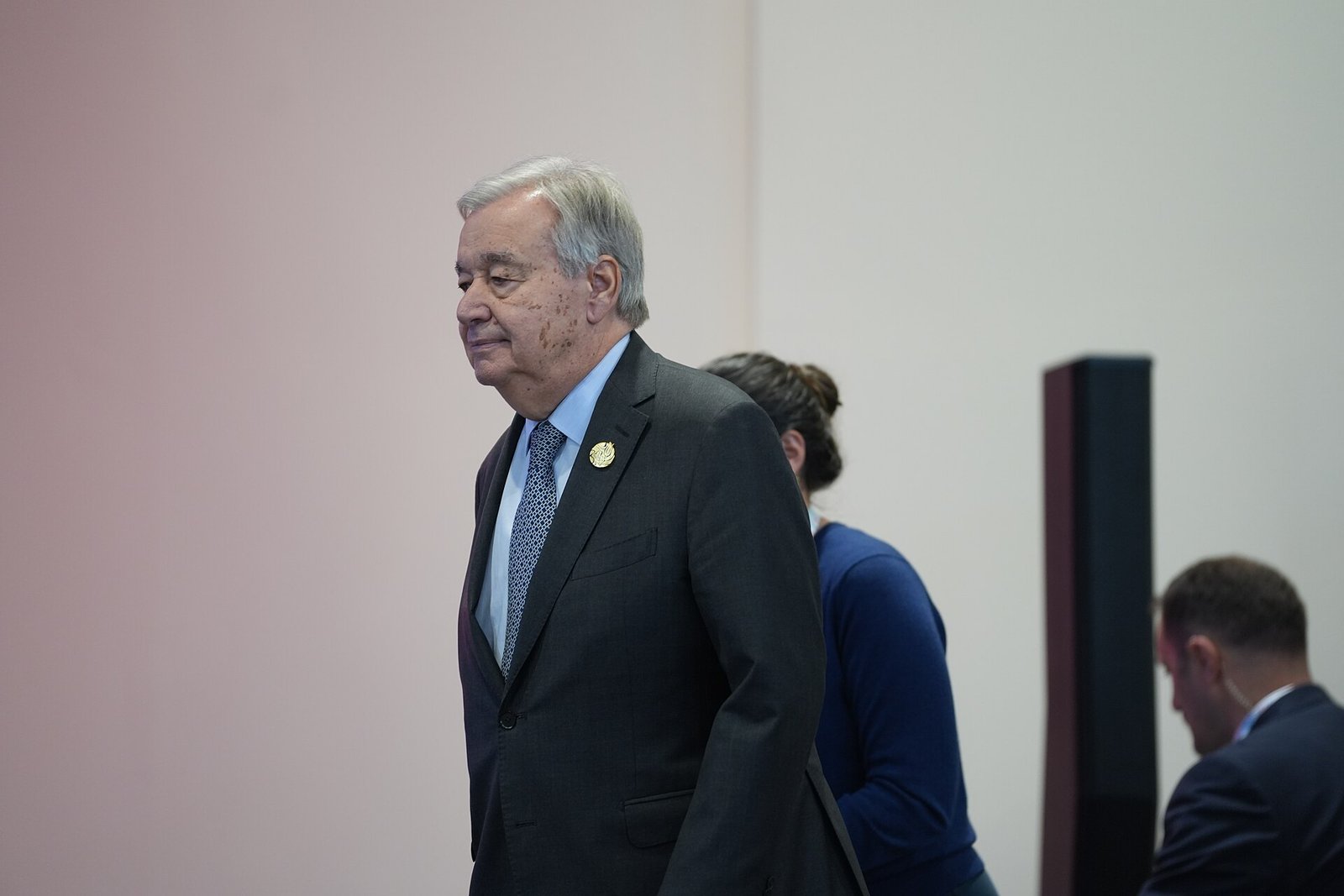
United Nations Secretary-General António Guterres on Monday called on governments to agree within a year on a global framework for managing the risks of artificial intelligence, warning that the technology is shifting power away from states faster than the institutions built after the Second World War can respond.
Speaking at the close of the Bridgetown Special Summit on AI Safety in Barbados, which the United Nations co-hosted with the Barbadian government, Guterres said protections against AI risks remain fragmented and governments are “playing catch-up”.
“Today I call for member states to coordinate efforts and to develop within the next year a globally inclusive and principles-based multilateral framework for AI risk management, backed by independent and credible oversight,” he told reporters. “Put simply, we need a common foundation for AI safety.”
The framework he proposed would rest on shared safety measures, common approaches to testing AI systems, clear safeguards and standards, basic transparency requirements, and independent evaluation and oversight of advanced AI models, with support so that every country can put them into practice.
Guterres warned that power is shifting “from States, from governing institutions to a small number of companies and persons”, and that the ability to turn AI into a weapon sits with a small number of countries and firms. He said AI systems are becoming more capable and more autonomous, bringing new cybersecurity risks and fresh possibilities for manipulation and misuse, and sometimes behaving in ways even their developers did not anticipate. “The future of AI cannot be decided by a few, for everyone else,” he said.
The appeal comes in the final weeks of Guterres’s term: he leaves office at the end of December, and his successor takes over in the new year. The Bridgetown summit brought together around 150 participants, including ministers from Norway and Finland, AI industry leaders, heads of AI safety institutes and members of the UN Independent International Scientific Panel on AI, whose first report found that AI guardrails are trailing capabilities. French President Emmanuel Macron addressed the summit remotely, and 18 national leaders and 11 figures from the AI industry have now endorsed the Paris Call for AI Security.
To narrow the gap between countries that can assess AI systems and those that cannot, Guterres has also proposed a Global Fund for AI Capacity-Building. Reports put its initial target at about $3 billion, though that figure has not been confirmed by the United Nations.
Guterres stressed that the framework would be neither a treaty nor a regulation, but a foundation countries can use to build their own national AI safety infrastructure. “As this technology develops and spreads, safety must come first. The way forward must include all countries,” he said.
Sources: UN News, “UN chief urges talks on global AI safety framework, warns of historic shift in power” (https://news.un.org/en/story/2026/11/1168861); UN Media (https://media.un.org/unifeed/en/asset/d369/d3693685).