









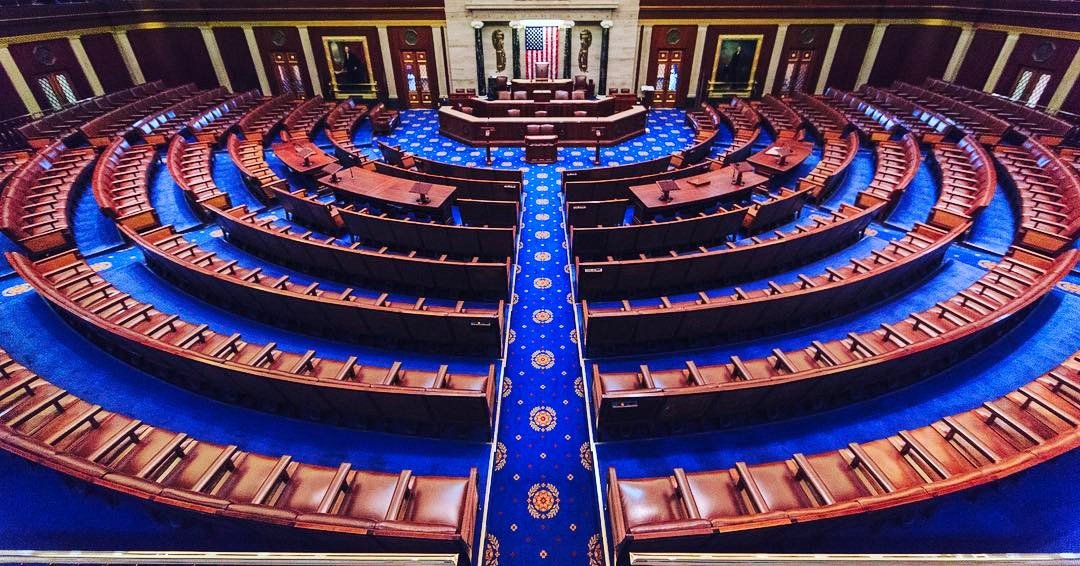
The US House of Representatives unconstitutionally passed a $1.7 trillion government funding bill in 2022 because hundreds of its members voted by proxy rather than in person, a federal appeals court ruled on Friday.
The full Fifth Circuit Court of Appeals in New Orleans voted 9-8 to uphold an injunction won by the outgoing Texas attorney general, Ken Paxton, blocking enforcement against Texas of one provision in the package: the Pregnant Workers Fairness Act, which requires employers to make reasonable accommodations for pregnant workers.
The proxy voting rule was introduced in May 2020 by the then speaker, Nancy Pelosi, as an emergency measure at the start of the Covid-19 pandemic. It was abandoned when Republicans took control of the House after the November 2022 elections. Before that, the House used it to pass the Consolidated Appropriations Act of 2023, the $1.7 trillion spending package, by 225 votes to 201 – with 226 members voting by proxy.
Writing for the majority, Judge Cory Wilson, appointed by President Donald Trump, held that the rule violated the Constitution’s quorum clause, which the court said requires a majority of members to be physically present to pass legislation. “While the chambers of the legislature have much discretion regarding their rules of procedure, the Quorum Clause’s constraints on congressional power cannot be circumvented by congressional fiat,” Wilson wrote.
The ruling’s immediate effect is narrow: it bars the Justice Department and the Equal Employment Opportunity Commission from enforcing the pregnant workers’ provision against Texas. But its logic reaches further. The same spending package also contained the Electoral Count Reform Act, which governs how Congress counts electoral votes in presidential elections, and legal commentators said the decision could invite fresh challenges to other measures passed under the proxy rule.
Judge James Graves, appointed by President Barack Obama, dissented, calling the ruling “illogical, inexplicable, and invalid”. He said the majority had read a physical-presence requirement into the quorum clause that does not exist, and offered no explanation for why, if the whole law was unconstitutionally passed, its ruling “should be limited only to one small sliver of the multitrillion dollar bill.”
The decision is expected to be appealed to the Supreme Court. A district judge first ruled for Texas in 2024; a Fifth Circuit panel later sided with Congress, before the full court agreed to rehear the case. The case is State of Texas v. Blanche.
Sources: Reuters – “US House unconstitutionally passed spending bill in 2022, court rules” (https://www.reuters.com/legal/government/us-house-unconstitutionally-passed-spending-bill-2022-court-rules-2026-11-21/); Bloomberg Law – “Congress Proxy-Voting Found Unconstitutional by Fifth Circuit” (https://news.bloomberglaw.com/us-law-week/congress-proxy-voting-found-unconstitutional-by-fifth-circuit).