








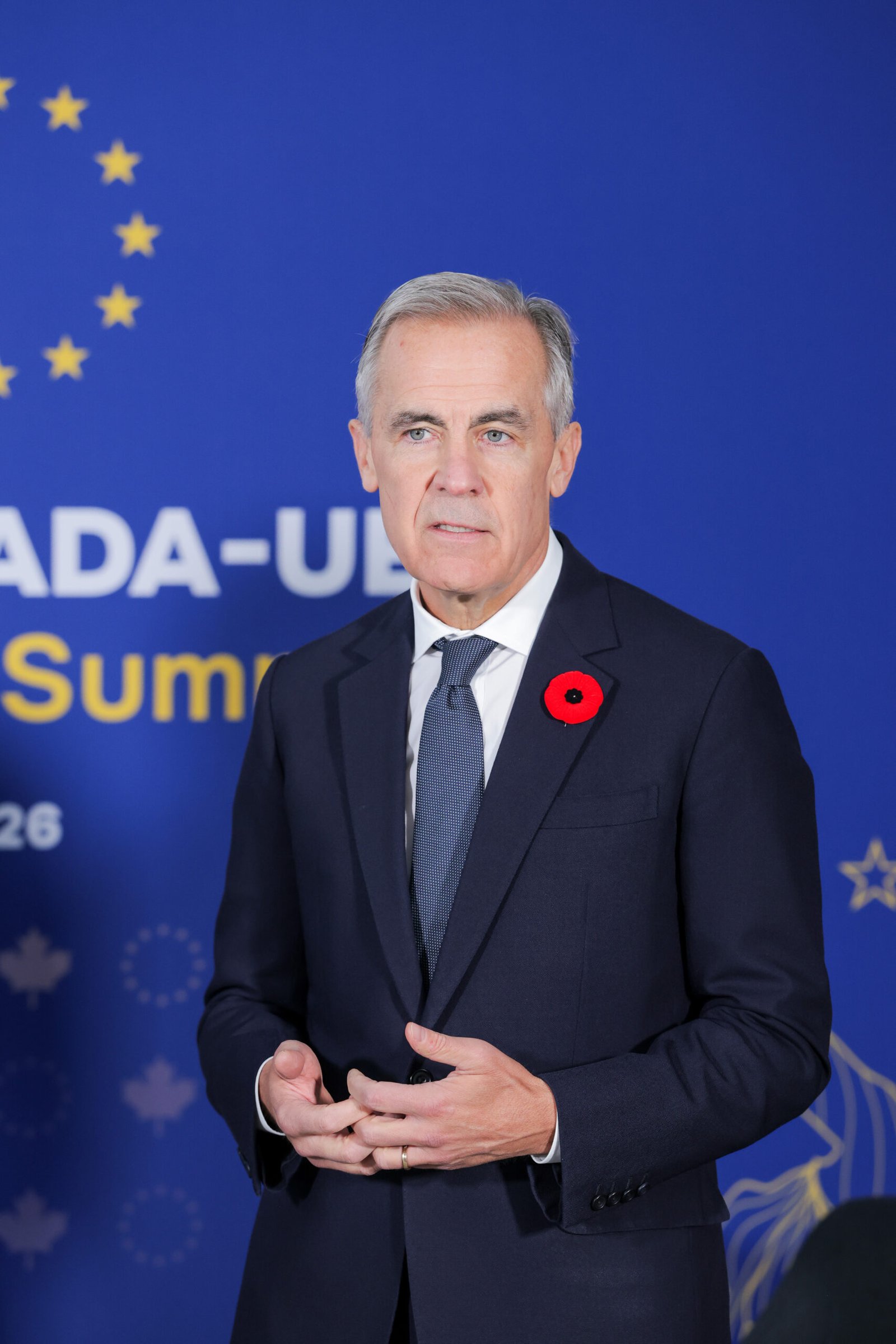
Canada and the European Union have launched a new “Alliance for the Future”, the deepest partnership in the history of their relationship, at a summit in Montreal aimed at shielding both sides from a more divided and unpredictable world.
The leaders announced the initiative on Friday at the close of their 21st summit, held on 29 and 30 October. Canadian Prime Minister Mark Carney hosted European Council President António Costa and European Commission President Ursula von der Leyen for two days of talks in the Quebec city.
In a joint statement, the two sides said the alliance would create “a common prosperity and economic security space”, built on shared values including democracy, human rights, the rule of law and open markets. It covers trade and regulation, digital and research technology, critical raw materials and energy, financial services, security and people-to-people ties.
Concrete deals accompanied the launch. The two sides concluded substantive negotiations on a digital trade agreement to supplement their existing free-trade deal, and agreed an arrangement allowing the European Investment Bank to finance critical minerals projects in Canada. Canada also joined the European High-Performance Computing Joint Undertaking, giving its researchers access to European supercomputers.
Ukraine was a central part of the summit. Carney announced that Canada would join the EU’s €90 billion support loan for Kyiv, with an initial contribution of €500 million, as Brussels seeks extra funding to cover Ukraine’s financing needs for 2026 and 2027.
The most striking language in the statement concerns Canada’s place alongside the bloc. The two sides will work to define, by the 2027 Canada-EU summit, “an ever-closer association of Canada to the EU, short of full membership itself”. Carney went further in public, saying Canada was on course to become the EU’s first associate member, though that term has no legal meaning and is opposed by some member states, including Germany.
Von der Leyen stressed that the alliance was not directed against any other country, while Carney framed it as a matter of sovereignty and resilience, pointing to cooperation on artificial intelligence, energy, critical minerals and quantum technology. The leaders also agreed to hold regular summits and joint ministerial meetings, and to explore deeper cooperation on Arctic security, satellite connectivity and student exchanges.
The summit builds on an already close relationship: trade in goods and services between Canada and the EU reached roughly €130 billion in 2025, and the two sides already share a free-trade agreement that eliminates tariffs on 98% of traded goods.
Sources: Government of Canada, “Joint Statement: Canada and the European Union building together an Alliance for the Future” (30 October 2026), https://www.pm.gc.ca/en/news/statements/2026/10/30/joint-statement-canada-and-european-union-building-together-alliance ; Reuters, “EU, Canada to define ‘ever-closer association’ by 2027 summit” (30 October 2026), https://www.reuters.com/world/eu-canada-define-ever-closer-association-by-2027-summit-2026-10-30/