







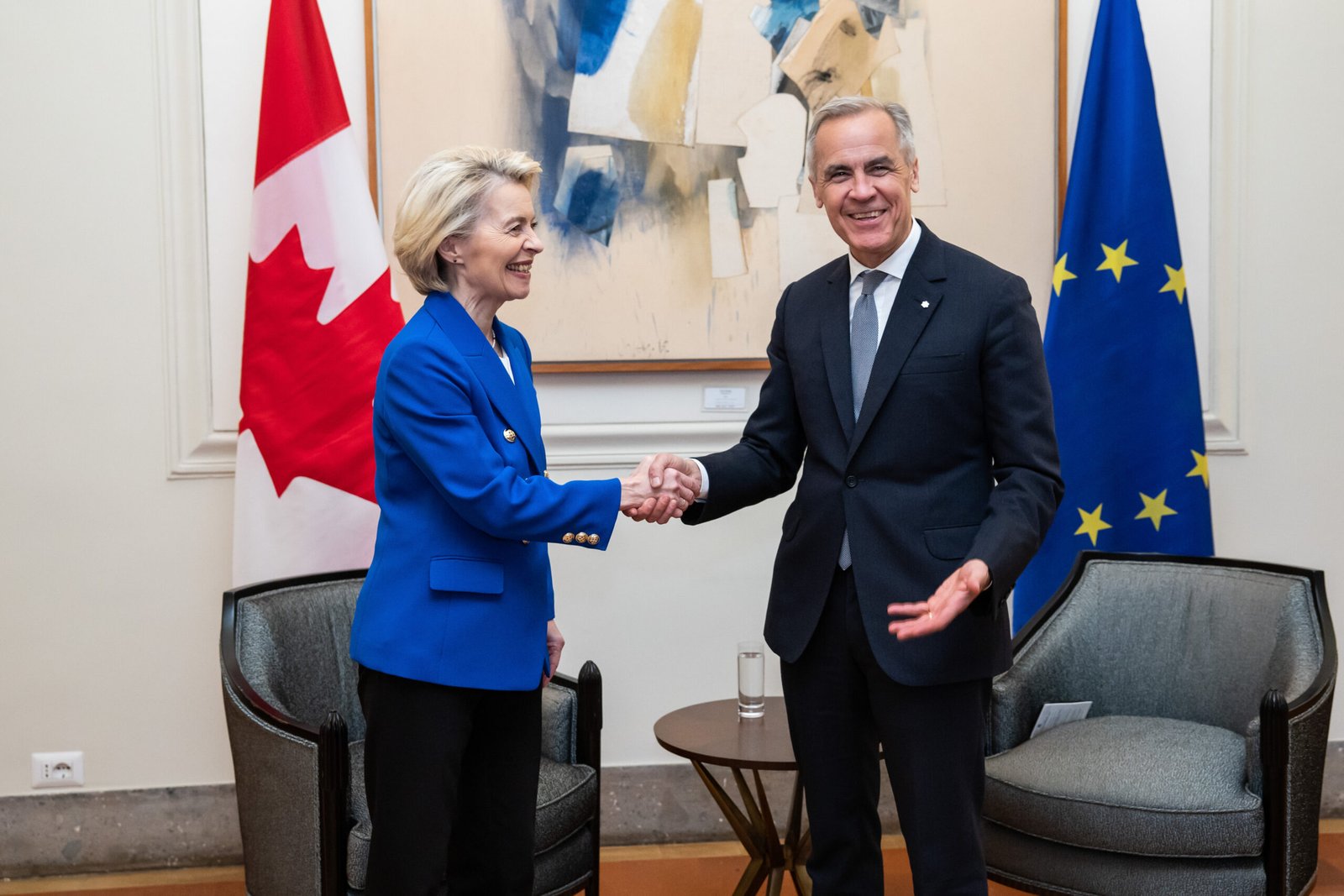
Canada and the European Union have launched a new partnership, the Alliance for the Future, aimed at creating what their leaders called a common prosperity and economic security space. The launch came at their 21st summit in Montréal on 29 and 30 October, where Canadian Prime Minister Mark Carney hosted European Council President António Costa and European Commission President Ursula von der Leyen.
In parallel, Canada and the EU are working towards what the Canadian Prime Minister’s Office described as the deepest possible partnership short of accession, with Canada becoming the European Union’s first Associate Member. The substance, scale and scope of that form of membership are still to be determined over the coming months.
That qualification matters. The leaders’ joint statement itself does not create a new membership category. Instead, it commits the two sides to define, by the 2027 EU-Canada Summit, the concept of an ever-closer association of Canada to the EU, short of full membership itself. Associate membership is therefore the stated direction of travel, not a status Canada has already acquired.
The summit nevertheless announced more than 20 measures. Canada and the EU concluded negotiations on a Digital Trade Agreement and on a second-generation Competition Agreement, and Canada joined the European High Performance Computing Joint Undertaking, giving Canadian researchers access to JUPITER, one of the world’s most powerful supercomputers. Canada also signed a treaty framework with the European Investment Bank to allow it to invest in Canadian critical minerals projects.
On defence and security, the announcements included a contract worth more than $44 million for Montréal-based Galvion to provide military helmets to Latvia, and up to $2.5 billion in financing for Alberta-based De Havilland to expand waterbomber production. Canada and the EU will also advance cooperation on the IRIS² satellite system and on navigation through the EU’s Galileo programme and the European Space Agency.
Further negotiations are planned on expanding Canada’s participation in Erasmus+, the EU’s student exchange programme, and on joining the next Horizon Europe research programme. The two sides will also work on connecting their instant payment systems, explore opening their banking, insurance and fintech markets further to each other, study a new transatlantic data cable, and assess the viability of increased Canadian liquefied natural gas exports to Europe.
The EU is Canada’s second-largest trading partner for goods and services, with trade worth approximately $178 billion in 2025, according to the Prime Minister’s Office. The joint statement also reaffirmed support for Ukraine, welcomed Canada’s intention to join the Ukraine Support Loan, and committed the partners to deeper cooperation in the Arctic, on democratic resilience and on reforming the World Trade Organization.
Carney framed the partnership as a response to a more dangerous and divided world, in which sovereignty now requires secure access to critical minerals, semiconductors, energy, vaccines, space-based communications and artificial intelligence. Whether the associate-member ambition becomes a formal arrangement will depend on the negotiations now under way, with the 2027 summit set as the point at which the concept is to be defined.
Sources: Prime Minister of Canada, “Canada and the European Union announce new Alliance for the Future to create greater affordability, opportunity, and sovereignty”, 30 October 2026, https://www.pm.gc.ca/en/news/news-releases/2026/10/30/canada-and-european-union-announce-new-alliance-future-create-greater ; Prime Minister of Canada, “Joint Statement: Canada and the European Union building together an Alliance for the Future”, 30 October 2026, https://www.pm.gc.ca/en/news/statements/2026/10/30/joint-statement-canada-and-european-union-building-together-alliance