








The James Webb Space Telescope has found water and carbon dioxide ice around the young star Beta Pictoris that appears to be older than the star itself, a discovery that may reshape how astronomers think about where the ingredients for water-rich planets come from.
Beta Pictoris sits about 64 light-years from Earth and is only around 20 million years old, a newborn by stellar standards. It is surrounded by a vast disk of dust and rubble in which planets are still forming; astronomers have already found three. A team led by Sarah Betti, an astronomer at the Space Telescope Science Institute in Baltimore, used Webb’s Near-Infrared Spectrograph to examine the light filtering through that disk, and found clear signatures of both water ice and carbon dioxide ice.
The surprise is in the ice’s structure. The water ice is glassy rather than crystalline, with less than 7 per cent of it in crystalline form. Models had predicted that the ice in such debris disks would be mostly crystalline. Glassy ice can only survive if it stays colder than 100 Kelvin; otherwise starlight or cosmic rays would rearrange its structure. That suggests this ice did not form around Beta Pictoris at all, but was inherited from the cold interstellar cloud that collapsed to form the star, preserving a chemical fingerprint from before the system existed.
The mix is familiar. The water ice is combined with carbon dioxide in roughly the same proportions found in the comets of our own Solar System, hinting that the raw materials for water-rich, potentially habitable worlds may be common around young stars across the galaxy.
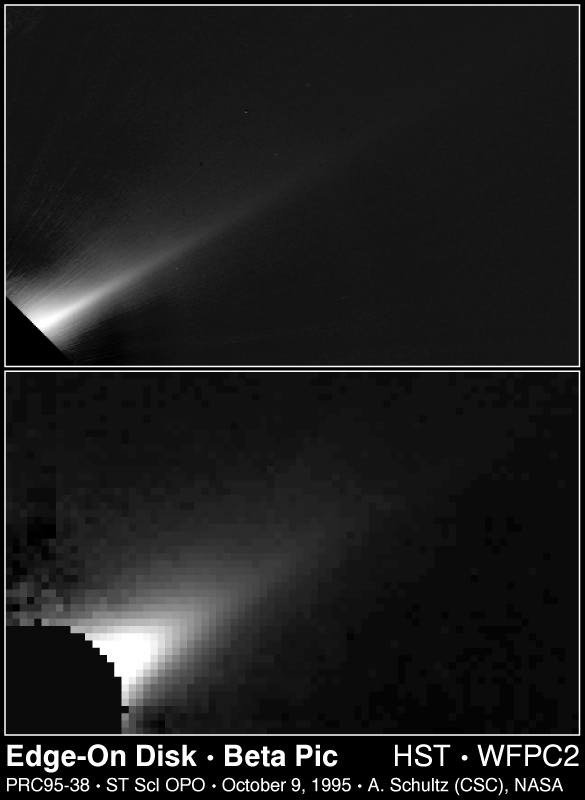
Beta Pictoris is one of the best-studied stars in the sky. Its disk was among the first ever imaged, in 1984, and we see it almost exactly edge-on, making it a natural laboratory for watching planetary systems grow. Its dust is constantly replenished by collisions among comets and planetesimals, the small bodies that are the building blocks of planets.
The findings were published in the journal Science on 14 November. They do not show that Beta Pictoris has watery planets, only that the ingredients are present and ancient. But if the same inheritance holds elsewhere, the water that fills Earth’s oceans may be far older than the Sun, and far more widely available, than astronomers once assumed.
Sources: Ars Technica, 14 November 2026; Space Telescope Science Institute; Science journal.