






A rose-coloured rock picked up in the Sahara Desert in 2022 has turned out to be one of the oldest pieces of Mars ever found on Earth, offering a rare glimpse of the planet as it was more than 4.1 billion years ago.
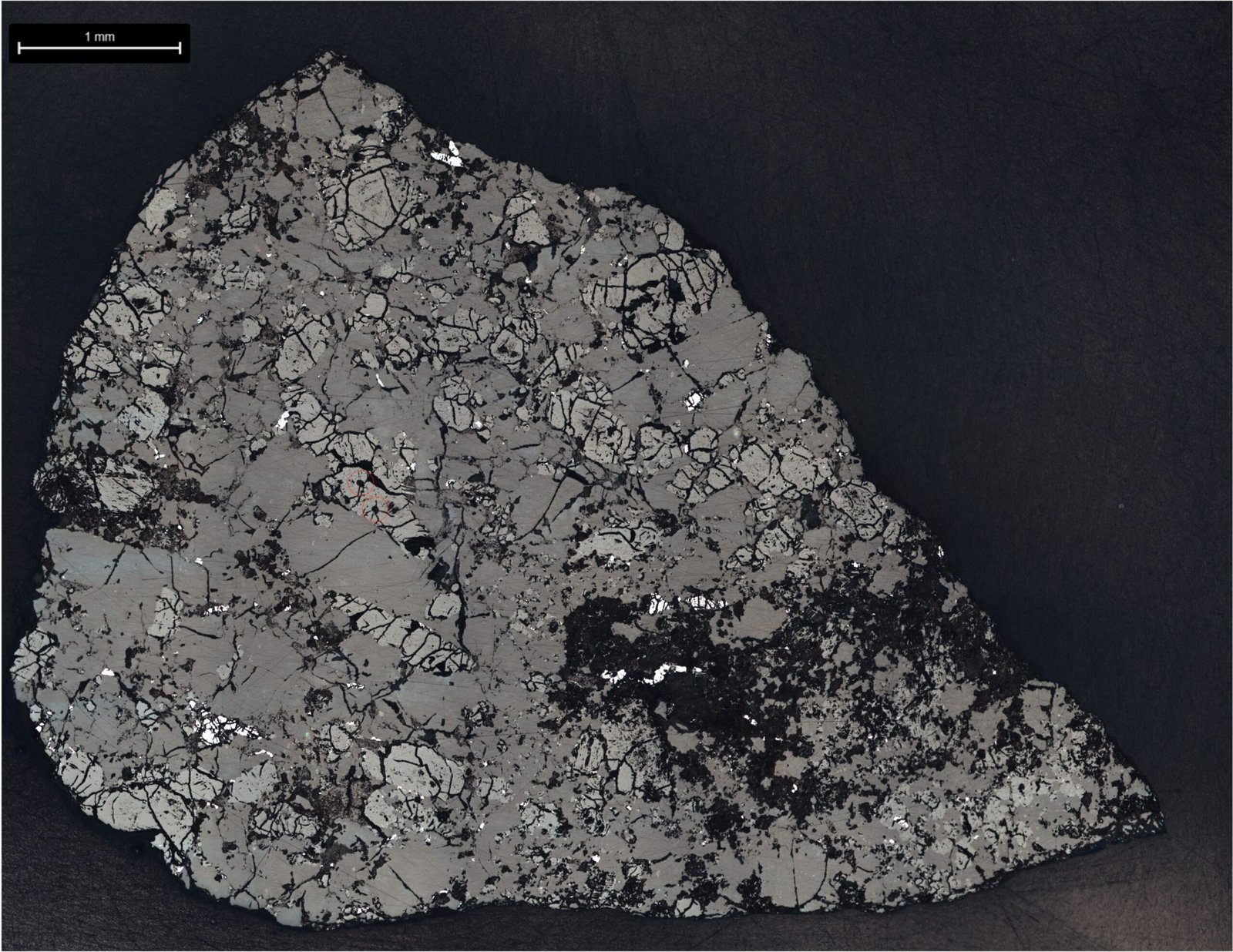
The meteorite, named Teghaza 001 after the salt plain in Mali where it was discovered, weighs just under 800 grams across eight fragments, the largest of them roughly 10 centimetres across. Scientists identified it as Martian from the oxygen isotopes in its minerals, which act as a geochemical fingerprint distinguishing rocks from Mars from those of Earth or other bodies.
A study published in the journal Science on 29 October, led by Yang Liu of NASA’s Jet Propulsion Laboratory, dated the rock using tiny zircon crystals embedded in it. Uranium-lead dating put its age at about 4.11 billion years, making it the oldest known Martian lava rock yet identified and one of only a handful of Martian meteorites from the planet’s earliest history. A separate rubidium-strontium analysis, carried out on a fragment smaller than a fingernail, gave a consistent age of about 4.24 billion years.
What makes Teghaza 001 stand out is not only its age but its composition. It is a leuco-gabbro, an igneous rock rich in plagioclase feldspar and pyroxene, formed when magma cooled slowly beneath the Martian surface rather than erupting as lava. That sets it apart from other ancient Martian samples: ALH84001, a meteorite of similar age, consists almost entirely of a single mineral, while the famous Black Beauty sample formed around 2.1 billion years ago.
The rock also carries signs that water moved through it. Some of its minerals were altered by liquid water or water-rich fluids, and they show traces of fluids enriched in oxygen-18, a heavier form of oxygen. A separate study of hydrogen isotopes in the meteorite’s apatite crystals, published in Science Advances in June, found that ancient Martian water had a deuterium-to-hydrogen ratio roughly twice that of Earth’s seawater — evidence that Mars lost large amounts of water to space as its atmosphere thinned.
“This is really our first piece of Martian crust from a part of Mars we’ve never had a sample of before,” said Lee Saper, a NASA scientist who worked on the study. “It records interactions of water and rock and maybe even an imprint of the Martian atmosphere as it was losing water.”
The researchers compared the meteorite’s mineralogy and chemistry with observations from NASA’s Mars Reconnaissance Orbiter and identified 13 locations that could match it, most of them in the planet’s ancient southern highlands, possibly north-west of the Hellas impact basin. Its precise birthplace, however, remains unknown, and the rock cannot by itself reconstruct Mars’ entire early environment. It says nothing about life: the findings concern the planet’s geology and water, not organisms.
The dating method itself may prove as useful as the rock. The in-situ technique, developed by a team at Caltech, measures individual mineral grains directly instead of dissolving a whole sample, which could allow other rare planetary specimens to be dated without destroying them.
Sources: CNN (https://www.cnn.com/2026/11/06/science/mars-meteorite-sahara-teghaza-discovery); Interesting Engineering (https://interestingengineering.com/space/piece-of-mars-watery-history); Yang Liu et al., Science, doi: 10.1126/science.adz5646 (https://doi.org/10.1126/science.adz5646).