





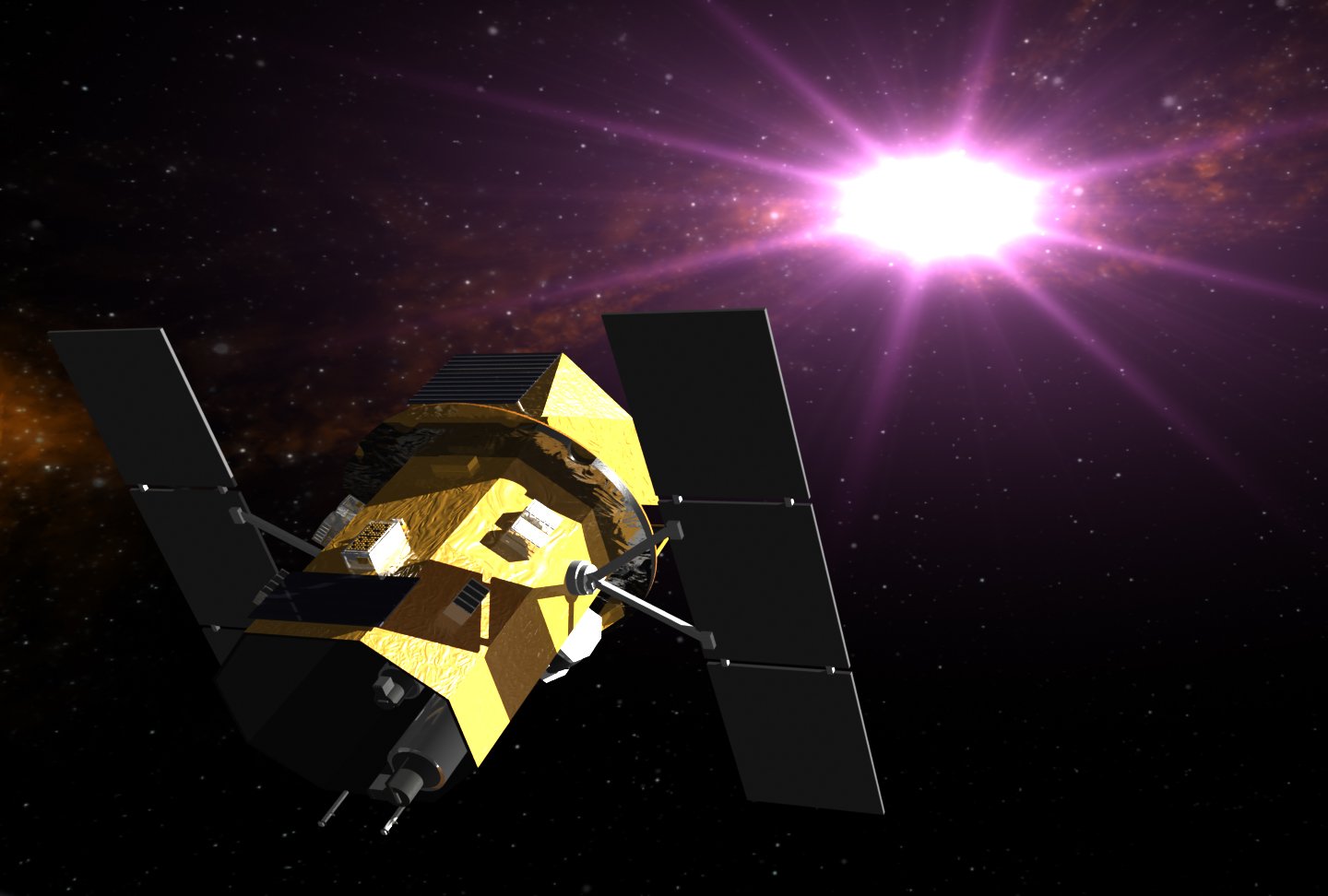
After almost 22 years chasing the universe’s most violent explosions, NASA’s Neil Gehrels Swift Observatory is running out of sky. Launched on 20 November 2004 to hunt gamma-ray bursts, the telescope has slipped so low that it can no longer hold steady enough to observe, and NASA shut its systems down in late October. It is now falling, uncontrolled, towards Earth.
Exactly when it will come down is not yet pinned down, and any single date should be treated as a forecast window rather than a promise. The US Space Force has put re-entry at around Friday 6 November, while a separate forecast from The Aerospace Corporation places it around 4 November, with an uncertainty of 26 hours either side. Trackers will narrow that window as atmospheric drag takes its course.
Most of the 1,470-kilogram spacecraft is expected to burn up as it meets ever denser air. But NASA mission chief scientist Brad Cenko has warned that some parts could make it through: pieces made from tungsten, a metal denser than lead, and fragments of the telescope’s mirrors. Any surviving wreckage is most likely to land in the ocean, although parts of Africa, northern Australia, India, Southeast Asia and Central and South America lie beneath its orbital path, and the final impact location remains unknown.
Swift’s descent quickened in recent years as intense solar activity increased drag on its low orbit. With no propulsion of its own to climb back up, the observatory was always destined to fall eventually. “We’ve known this day would come since before Swift was launched,” said John Nousek, a Penn State astronomer who led Swift’s control team.
NASA tried to cheat that fate. About a year ago it hired Katalyst Space to mount a hurried rescue, sending a three-armed robotic spacecraft called Link to grab Swift and push it into a higher orbit. Link launched in July but ran into trouble and got no closer than about 12 to 15 kilometres from its target — far short of the contact needed to grapple it. Link itself fell back to Earth in September, and NASA formally ended its involvement in the attempt on 3 September.
Freed from the rescue effort, Swift briefly went back to work, detecting still more gamma-ray bursts and other high-energy events. But by late October its altitude had dropped too far for stable observations, and its mission was brought to a close. Its final tally stands at more than 2,000 gamma-ray bursts and 1,400 exploding stars, alongside comets, asteroids and stars shredded by black holes.
Swift earned its name from its ability to swivel swiftly towards erupting events, and NASA treated it as a first responder for larger telescopes: its alerts sent Hubble, Webb and others chasing the same explosions for deeper study. Scientists are still working out how to fill that gap, and Nousek said his hope was that lessons from Swift’s successes could be applied to new missions and speed up discoveries about the universe.
Sources: Associated Press, “NASA’s Swift telescope on the verge of plunging back to Earth”, 1 November 2026, via https://www.byteseu.com/2489248/ ; and “NASA’s Swift Space Telescope Set to Fall Back to Earth After Failed Rescue Mission”, 1 November 2026, https://www.abovethenormnews.com/2026/11/01/nasa-swift-telescope-re-entry/